MCQ
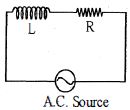
In a simple $L-R$ circuit with $A.C$. source the potential difference at any instant across inductor and resistance are $V_L$ and $V_R$ respectively and $A.C.$ souree has potential difference $V_{Ac}$ at the same instant. Then
  • A
    $V_L^2 + V_R^2 = V_{AC}^2$
  • ${V_L} + {V_R} = {V_{AC}}$
  • C
    $V_L^2 - V_R^2 = V_{AC}^2$
  • D
    $V_L^3 + V_R^3 = V_{AC}^3$

Answer

Correct option: B.
${V_L} + {V_R} = {V_{AC}}$
b
Instantaneous sum of potential difference
$V_R = V_L + V_C$

Need a full question paper?

Generate a complete, print-ready paper with questions like this in minutes — across 16+ boards, with answer keys.

Start Generating Free

Similar questions

Sound waves of wavelength greater than that of audible sound are called
In which of the following graphs, the total change in momentum is zero?
Two small metal balls of different masses $m_1$ and $m_2$ are connected by strings of equal length to a fixed point. When the balls are given equal charges, the angles that the two strings make with the vertical are $30^{\circ}$ and $60^{\circ}$, respectively. The ratio $m_1 / m_2$ is close to
The magnetic field at the centre due to motion electron in first Bohr orbit is $'B'$ . The magnetic field due to motion of electron in second Bohr orbit at the centre will be
Two stones are thrown up simultaneously with initial speeds of ' $u_1$ and $u_2\left(u_2 > u_1\right)$. They hit the ground after $6\,s$ and $10\,s$ respectively. Which graph in figure correctly represents the time variation of $\Delta x=\left(x_2-x_1\right)$, the relative position of the second stone with respect to the first upto $t=10\,s$ ? Assume that the stones do not rebound after hitting the ground.
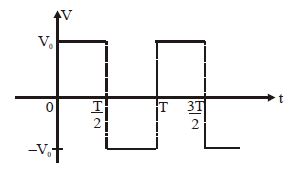
The mean and $rms$ value of an alternating voltage for half cycle as shown in figure are  respectively:-
An electron and proton are separated by a large distance. The electron starts approaching the proton with energy $3\, {eV}$. The proton captures the electrons and forms a hydrogen atom in second excited state. The resulting photon is incident on a photosensitive metal of threshold wavelength $4000\, \mathring {{A}}$. What is the maximum kinetic energy of the emitted photoelectron ? (In ${eV}$)
A thin square steel plate with each side equal to $10$ cm is heated by a blacksmith. The rate of radiated energy by the heated plate is $1134 W$ . The temperature of the hot steel plate is ....... $K$ (Stefan's constant $\sigma = 5.67 \times {10^{ - 8}}watt\;{m^{ - 2}}{K^{ - 4}}$, emissivity of the plate = $1$ )
Two blocks $A$ and $B$ of masses $5 \,kg$ and $3 \,kg$ respectively rest on a smooth horizontal surface with $B$ over $A$. The coefficient of friction between $A$ and $B$ is $0.5$. The maximum horizontal force (in $kg$ wt.) that can be applied to $A$, so that there will be motion of $A$ and $B$ without relative slipping, is
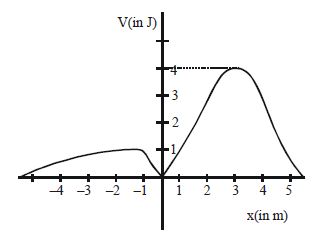
A point particle of mass $0.\ 5 kg$ is moving along the $x-$ axis under a force described by the potential energy $V$ shown below. It is projected towards the right from the origin with a speed $v$ . What is the minimum value of $v$ for which the particle will escape infinitely far away from the origin ? ............... $\ ms^{-1}$