Question
In a single slit diffraction experiment, when a tiny circular obstacle is placed in the path of light from a distant source, a bright spot is seen at the centre of the shadow of the obstacle. Explain why? State two points of difference between the interference pattern obtained in Young’s double slit experiment and the diffraction pattern due to a single slit.
Answer

Explanation: Waves diffracted at the edge of circular obstacle interfere constructively at the centre of the shadow producing a bright spot.
Points of Differences:
  1. In interference, All bright fringes are of equal intensity, while in diffraction intensity of secondary maxima keeps on decreasing.
  2. Width of all fringes are equal in interference pattern but, in diffraction the width of central maximum and  the secondary maxima are different.

Need a full question paper?

Generate a complete, print-ready paper with questions like this in minutes — across 16+ boards, with answer keys.

Start Generating Free

Similar questions

A vertical cylinder of height $100\ cm$ contains air at a constant temperature. The top is closed by a frictionless light piston. The atmospheric pressure is equal to $75\ cm$ of mercury. Mercury is slowly poured over the piston. Find the maximum height of the mercury column that can be put on the piston.
Explain the shortcomings of Bohr's Theory.
A charge $Q$ is uniformly distributed over a rod of length l. Consider a hypothetical cube of edge l with the centre of the cube at one end of the rod. Find the minimum possible flux of the electric field through the entire surface of the cube.
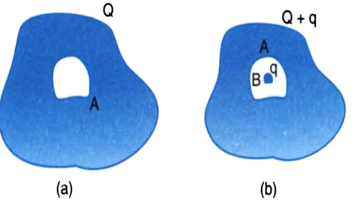
  1. A conductor A with a cavity as shown in Fig. 1.36(a) is given a charge Q. Show that the entire charge must appear on the outer surface of the conductor.
  2. Another conductor B with charge q is inserted into the cavity keeping B insulated from A. Show that the total charge on the outside surface of A is Q + q [Fig. 1.36(b)].
  3. A sensitive instrument is to be shielded from the strong electrostatic fields in its environment. Suggest a possible way.
An electron microscope uses electrons accelerated by a voltage of $50\ kV$. Determine the de Broglie wavelength associated with the electrons. If other factors $($such as numerical aperture, etc.$)$ are taken to be roughly the same, how does the resolving power of an electron microscope compare with that of an optical microscope which uses yellow light?
The number of electrons in an insulator is of the same order as the number of electrons in a conductor. What is then the basic difference between a conductor and an insulator?
A cubical block of mass m and edge a slides down a rough inclined plane of inclination $\theta$ with a uniform speed. Find the torque of the normal force acting on the block about its centre.
The numerical value of ionization energy in $eV$ equals the ionization potential in volts. Does the equality hold if these quantities are measured in some other units?
Derive the formula of electric field for a point on the axis of electric dipole.
A charge Q is distributed uniformly over a metallic sphere of radius R. Obtain the expressions for the electric field (E) and electric potential (V) at a point 0 < x < R.
Show on a plot the variation of E and V with x for 0 < x < 2R.