MCQ
In a sinusoidal wave, the time required for a particular point to move from maximum displacement to zero displacement is $0.170\,$second. The frequency of the wave is .... $Hz$
  • $1.47$
  • B
    $0.36$
  • C
    $0.73$
  • D
    $2.94$

Answer

Correct option: A.
$1.47$
a
(a) Time required for a point to move from maximum displacement to zero displacement is

$t = \frac{T}{4} = \frac{1}{{4n}}$
==> $n = \frac{1}{{4t}} = \frac{1}{{4 \times 0.170}} = 1.47\,Hz$

Need a full question paper?

Generate a complete, print-ready paper with questions like this in minutes — across 16+ boards, with answer keys.
Start Generating Free

Similar questions

A current through a wire depends on time as $i =\alpha_{0} t +\beta t ^{2}$ where $\alpha_{0}=20 A / s$ and $\beta=8 As ^{-2} .$ Find the charge crossed through a section of the wire in $15 \,s$ (in $C$)
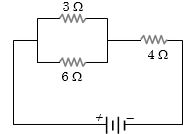
In the figure, current through the $3\,\Omega $ resistor is $0.8\, ampere$, then potential drop through $4\,\Omega $ resistor is ........... $V$
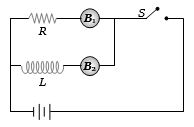
The adjoining figure shows two bulbs $B_1$ and $B_2$ resistor $R$ and an inductor $L$ When the switch $S$ is turned off
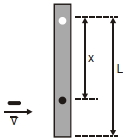
A rod of mass $m$ and length $L$, pivoted at one of its ends, is hanging vertically. A bullet of the same mass moving at speed $v$ strikes the rod horizontally at a distance $x$ from its pivoted end and gets embedded in it. The combined system now rotates with angular speed $\omega$ about the pivot. The maximum angular speed $\omega_M$ is achieved for $x=x_M$. Then

$(A)$ $\omega=\frac{3 v x}{ L ^2+3 x^2}$

$(B)$ $\omega=\frac{12 v x}{L^2+12 x^2}$

$(C)$ $x_M=\frac{L}{\sqrt{3}}$

$(D)$ $\omega_M=\frac{v}{2 L} \sqrt{3}$
Amplitude modulated wave is represented by

$V _{ AM }=10\left[1+0.4 \cos \left(2 \pi \times 10^{4} t \right)\right] \cos \left(2 \pi \times 10^{7} t \right) \text {. }$

The total bandwidth of the amplitude modulated wave is

The sensitivity of a Galvenometer of resistance $171\,\Omega $ becomes $20\,times$ when we used shunt of $x \,\Omega .$ Find $x$ ................. $\Omega$
Which of the following graphs best represents the motion of a raindrop?
The specific heat of the mixture of two gases at constant volume is $\frac {13}{6}\,R$ . The ratio of number of moles of first gas to second is $1 : 2$. The respective gases may be
A particle executing simple harmonic motion along $Y- $axis has its motion described by the equation $y = A\sin (\omega \,t) + B$. The amplitude of the simple harmonic motion is
The human eye has a lens which has a