Question
In a stationary wave, all particles are

Answer

(a) In a stationary wave, all particles are at rest at the same twice in every period of oscillation.

Hence, Option $A$ is correct.

Need a full question paper?

Generate a complete, print-ready paper with questions like this in minutes — across 16+ boards, with answer keys.
Start Generating Free

Similar questions

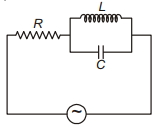
In the given $A.C.$ circuit, the instantaneous current through inductor and capacitor are $0.8 \,A$ and $0.4 \,A$ respectively. The instantaneous current through resistor is ........ 
The resultant of two vectors $\overrightarrow P $ and $\overrightarrow Q $ is $\overrightarrow R .$ If $Q$ is doubled, the new resultant is perpendicular to $P$. Then $R $ equals
On which of the following scales of temperature, the temperature is never negative
If a particle takes $t$ second less and acquires a velocity of $v \ ms^{^{-1}}$ more in falling through the same distance (starting from rest) on two planets where the accelerations due to gravity are $2 \,\, g$ and $8 \,\,g$ respectively then $v=$
Two different magnets are tied together and allowed to vibrate in a horizontal plane. When their like poles are joined, time period of oscillation is $5 \,s$ and with unlike poles joined, time period of oscillation is $15 \,s$. The ratio of their magnetic moments is
A polyatomic gas with six degrees of freedom does $25\,\,J$ of work when it is expanded at constant pressure. The heat given to the gas is ..... $J$
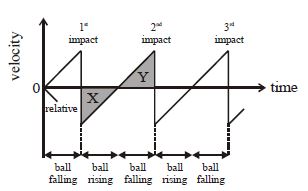
A steel ball is released from rest a distance above a rigid horizontal surface and bounces several time. The diagram shows how its velocity varies with time. Which statement correctly explains why the areas $X$ and $Y$ are equal?
The lines of forces due to earth's horizontal component of magnetic field are
To observe a stationary interference pattern formed by two light waves, it is not necessary that they must have :
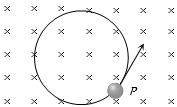
A particle having a charge of $10.0\,\mu C$ and mass $1\,\mu g$ moves in a circle of radius $10\,cm$ under the influence of a magnetic field of induction $0.1\,T$. When the particle is at a point $P$, a uniform electric field is switched on so that the particle starts moving along the tangent with a uniform velocity. The electric field is......$V/m$