MCQ
In a stretched string,
  • A
    Only transverse waves can exist
  • B
    Only longitudinal waves can exist
  • Both transverse and longitudinal waves can exist
  • D
    None of these

Answer

Correct option: C.
Both transverse and longitudinal waves can exist
c
(c)

In a solid both transverse and longitudinal waves may pass.

Need a full question paper?

Generate a complete, print-ready paper with questions like this in minutes — across 16+ boards, with answer keys.
Start Generating Free

Similar questions

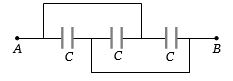
Three equal capacitors, each with capacitance $C$ are connected as shown in figure. Then the equivalent capacitance between $A$ and $B$ is
Unit of power is
Which of the following circular rods. (given radius $ r$ and length $l$ ) each made of the same material as whose ends are maintained at the same temperature will conduct most heat
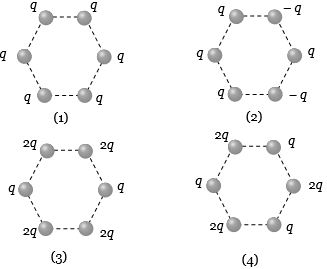
Figures below show regular hexagons, with charges at the vertices. In which of the following cases the electric field at the centre is not zero
In a series $RLC$ circuit, the $r.m.s.$ voltage across the resistor and the inductor are respectively $400 \,V$ and $700 \,V$. If the equation for the applied voltage is $\varepsilon=500 \sqrt{2} \sin \omega t$, then the peak voltage across the capacitor is ........... $V$
In which of the following the final image is erect?
Four lowest energy levels of $H-$atom are shown in the figure. The number of possible emission lines would be
Two spherical stars $A$ and $B$ have densities $\rho_A$ and $\rho_B$, respectively. $A$ and $B$ have the same radius, and their masses $M_A$ and $M_B$ are related by $M_B=2 M_A$. Due to an interaction process, star $A$ loses some of its mass, so that its radius is halved, while its spherical shape is retained, and its density remains $\rho_A$. The entire mass lost by $A$ is deposited as a thick spherical shell on $B$ with the density of the shell being $\rho_4$. If $v_A$ and $v_B$ are the escape velocities from $A$ and $B$ after the interaction process, the ratio $\frac{v_B}{v_A}=\sqrt{\frac{10 n}{15^{1 / 3}}}$. The value of $n$ is. . . . .
Given that a force $\vec F$ acts on a body for time $t_1$ and displaces the body by $\vec d$ . In which of the following cases the velocity of the body must increase?
A force of $5\, N$ acts on a $15\, kg$ body initially at rest. The work done by the force during the first second of motion of the body is