MCQ
In a stretched string,
  • A
    Only transverse waves can exist
  • B
    Only longitudinal waves can exist
  • Both transverse and longitudinal waves can exist
  • D
    None of these

Answer

Correct option: C.
Both transverse and longitudinal waves can exist
c
(c)

In a solid both transverse and longitudinal waves may pass.

Need a full question paper?

Generate a complete, print-ready paper with questions like this in minutes — across 16+ boards, with answer keys.
Start Generating Free

Similar questions

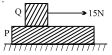
$A$ long plank $P$ of the mass $5\, kg$ is placed on a smooth floor. On $P$ is placed a block $Q$ of mass $2\, kg$. The coefficient of friction between $P$ and $Q$ is $0.5$. If a horizontal force $15N$ is applied to $Q$, as shown, and you may take $g$ as $10N/kg.$
The maximum energy in the thermal radiation from a hot source occurs at a wavelength of $11 \times {10^{ - 5}}cm$. According to Wein's law, the temperature of the source (on Kelvin scale) will be $n$ times the temperature of another source (on Kelvin scale) for which the wavelength at maximum energy is $5.5 \times {10^{ - 5}}cm$. The value $n$ is
A coconut fruit hanging high in a palm tree has ......... owing to its location.
A vessel contain a liquid has a constant acceleration $19.6 \,m / s ^2$ in horizontal direction. The free surface of water get sloped with horizontal at angle .......... 
A particle is moving in a straight line and passes through a point $O$ with a velocity of $6\;m{s^{ - 1}}.$ The particle moves with a constant retardation of $2\;m{s^{ - 2}}\;$ for $4$ s and there after moves with constant velocity. How long after leaving $O$ does the particle return to $O$..........$s$
If the average life of a person is taken as $100 \,s$, the age of the universe on this scale is of the order ...... $s$
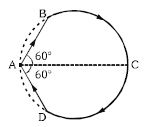
Consider a circle of radius $42\  cm$. An insect crawls with uniform speed of $1.3\  cm/s$ along the chord $AB$ then along the circular arc $BCD$ to reach point $D$ and then following cord $DA$ to reach finally $A$. Time spend by the insect to crawl from $A$ to $A$ is closest to    ......... $\sec$
The motion of a particle is given by $\text{x = A}\sin\omega\text{t+B}\cos\omega\text{t}.$ The motion of the particle is:
  1. Not simple harmonic.
  2. Simple harmonic with amplitude A + B.
  3. Simple harmonic with amplitude $\frac{\text{(A}+\text{B)}}{2}.$
  4. Simple harmonic with amplitude $\sqrt{(\text{A}^2+\text{B}^2)}.$
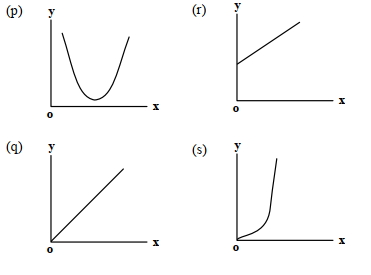
Column $I$ gives a list of possible set of parameters measured in some experiments. The variations of the parameters in the form of graphs are shown in Column $II$. Match the set of parameters given in Column $I$ with the graph given in Column $II$. Indicate your answer by darkening the appropriate bubbles of the $4 \times 4$ matrix given in the $ORS$.
Column $I$ Column $II$
$(A)$ Potential energy of a simple pendulum (y axis) as a function of displacement ( $\mathrm{x}$ axis) $Image$
$(B)$ Displacement (y axis) as a function of time (x axis) for a one dimensional motion at zero or constant acceleration when the body is moving along the positive $\mathrm{x}$-direction $Image$
$(C)$ Range of a projectile (y axis) as a function of its velocity ( $\mathrm{x}$ axis) when projected at a fixed angle $Image$
$(D)$ The square of the time period (y axis) of a simple pendulum as a function of its length ( $\mathrm{x}$ axis) $Image$