MCQ
In a system of particles, internal forces can change (for the system)
  • A
    The linear momentum but not the kinetic energy
  • The kinetic energy but not the linear momentum
  • C
    Linear momentum as well as kinetic energy
  • D
    Neither the linear mometum nor the kinetic energy
Answer

Correct option: B.
The kinetic energy but not the linear momentum
b
Due to the work done by internal for os kinetic energy of system of particles can change but both action and reaction of internal forces are there within the system so no change in momentum take place.

Need a full question paper?

Generate a complete, print-ready paper with questions like this in minutes — across 16+ boards, with answer keys.

Start Generating Free

Similar questions

A car is moving with speed $30$ $m/\sec $ on a circular path of radius $500\, m$. Its speed is increasing at the rate of $2m/{\sec ^2},$ What is the acceleration of the car ........ $m/sec^2$
A $2 \,kg$ block is lying on a smooth table which is connected by a body of mass $1\, kg$ by a string which passes through a pulley. The $1\, kg$ mass is hanging vertically. The acceleration of block and tension in the string will be
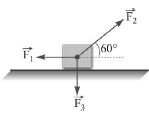
Figure shows three forces applied to a trunk that moves leftward by $3\, m$ over a smooth floor. The force magnitudes are $F_1 = 5\,N, F_2 = 9\,N$, and $F_3 = 3\,N$. The net work done on the trunk by the three forces ............... $\mathrm{J}$
(i) What is the work done by the porter when he climbs up a height of 10m (g = 10 ms−2)?
$A$ ladder of length $L$ is slipping with its ends against a vertical wall and a horizontal floor. At a certain moment, the speed of the end in contact with the horizontal floor is $v$ and the ladder makes an angle $\alpha = 30^o$ with the horizontal. Then the speed of the ladder’s center must be
A body is imparted motion from rest to move in a straight line. If it is then obstructed by an opposite force, then
The value of $(\overrightarrow A + \overrightarrow B )\, \times (\overrightarrow A - \overrightarrow B )$ is
The velocity of a body depends on time according to the equation $v=\frac{t^2}{10}+20$. The body is undergoing
110J of heat are added to a gaseous system and its internal energy increases by 40J, then the amount of work done is:
The velocity of a particle moving in the positive direction of $x$-axis varies as $v=5 \sqrt{x}$. Assuming that at $t=0$, particle was at $x=0$. What is the acceleration of the particle $.........m/s^2$