MCQ
In a transistor configuration $b-$parameter is
  • A
    $\frac{ l _{ b }}{ l _{ c }}$
  • $\frac{ l _{ c }}{ l _{ b }}$
  • C
    $\frac{ l _{ c }}{ l _{ a }}$
  • D
    $\frac{ l _{ a }}{ l _{ c }}$

Answer

Correct option: B.
$\frac{ l _{ c }}{ l _{ b }}$

Need a full question paper?

Generate a complete, print-ready paper with questions like this in minutes — across 16+ boards, with answer keys.
Start Generating Free

Similar questions

If a full wave rectifier circuit is operating from 50 Hz mains, the fundamental frequency in the ripple will be(a) 50 Hz (b) 70.7 Hz(c) 100 Hz(d) 25 Hz
       
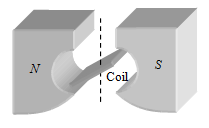
The figure below shows the north and south poles of a permanent magnet in which $n$ turn coil of area of cross$-$section $A$ is resting, such that for a current $i$ passed through the coil, the plane of the coil makes an angle $\theta$ with respect to the direction of magnetic field $B.$ If the plane of the magnetic field and the coil are horizontal and vertical respectively, the torque on the coil will be
since the magnetic field is radial
The count rate of a Geiger $-$ Muller counter for the radiation of a radioactive material of half life of $30$ minutes decreases to $5^{s^{-1}}$ after $2$ hours. The initial count rate was
A coil has an inductance of 0.7 H and is joined in series with a resistance of $220\Omega$ When an alternating emf of 220V at 50 cps is applied to it, then the wattless component of the current in the circuit is $(\text{take }0.7\pi=2.2)$
The ratio of the wavelengths for $2 \rightarrow 1$ transition in $Li^{++}, He^+$ and $H$ is
Dr. Gilbert tried to hold a brass rod by hand and induce static electricity in it by friction. Why did he fail?
The impurity to be dopped in pure germanium so as to make it $p$-type semiconductor is :
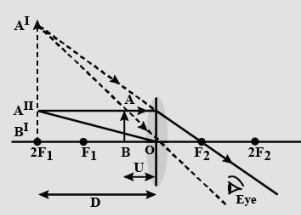
Figure shows the ray diagram of a:
The magnetic potential at a point on the axial line of a bar magnet of dipole moment $M$ is $V.$ What is the magnetic potential due to a bar magnet of dipole moment $\frac{M}{4}$ at the same point
A current passes through a resistor. Let $K_1$ and $K_2$ represent the average kinetic energy of the conduction electrons and the metal ions, respectively: