MCQ
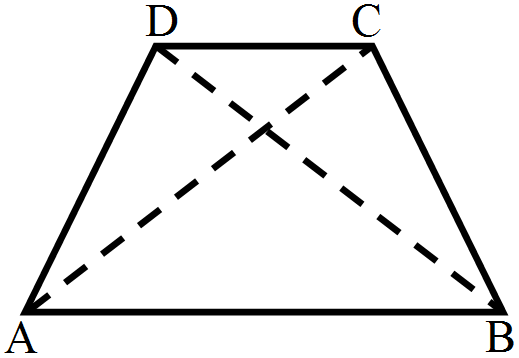
In a trapezium $A B C D$, if $A B \| C D$, then $\left(A C^2+B D^2\right)=$ ?
- A$B C^2+A D^2+2 B C \cdot A D$
- B$A B^2+C D^2+2 A B \cdot C D$
- C$A B^2+C D^2+2 A D \cdot B C$
- ✓$B C^2+A D^2+2 A B \cdot C D$
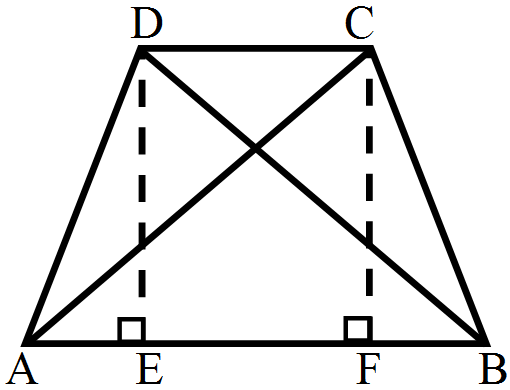
Construction: Draw perpendicular from $D$ and $C$ on $AB$ which meets $AB$ at $E$ and $F,$ respectively.
So, $DEFC$ is a parallelogram, since one pair of opposite sides are parallel and equal.
In $\triangle\text{ABC},$
$\angle\text{B}$ is an acute angle.
$\Rightarrow\text{AC}^2=\text{BC}^2+\text{AB}^2-2\text{AB}\times\text{AE}$
In $\triangle\text{ABD},$
$\angle\text{A}$ is an acute angle.
$\Rightarrow\text{BD}^2=\text{AD}^2+\text{AB}^2-2\text{AB}\times\text{AF}$
$\Rightarrow\text{AC}^2+\text{BD}^2=\text{BC}^2+\text{AD}^2+2\text{AB}(\text{AB}-\text{BE}-\text{AF})$
$=\text{BC}^2+\text{AD}^2+2\text{AB}\times\text{EF}$
$=\text{BC}^2+\text{AD}^2+2\text{AB}\times\text{CD}$
Generate a complete, print-ready paper with questions like this in minutes — across 16+ boards, with answer keys.