MCQ
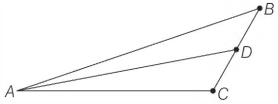
In a $\triangle A B C$ with $\angle A<\angle B<\angle C$, points $D, E, F$ are on the interior of segments $B C, C A, A B$ respectively. Which of the following triangles cannot be similar to $\triangle A B C ?$
  • $\triangle A B D$
  • B
    $\triangle B C E$
  • C
    $\triangle C A F$
  • D
     $\triangle D E F$

Answer

Correct option: A.
$\triangle A B D$
a
(a)

In $\triangle A B C, \angle A < \angle B < \angle C$

In $\triangle A B D, \quad \angle D > \angle C$

So, $\triangle A B D$ not similar to $\triangle A B C$.

Need a full question paper?

Generate a complete, print-ready paper with questions like this in minutes — across 16+ boards, with answer keys.

Start Generating Free

Similar questions

Let $n$ be the smallest positive integer such that $1+\frac{1}{2}+\frac{1}{3}+\ldots+\frac{1}{n} \geq 4$. Which one of the following statements is true?
The value of $\mathop {\lim }\limits_{x \to - \infty } \frac{{\sqrt {4{x^2} + 5x + 8} }}{{4x + 5}} $ is
The locus of a point which moves in such a way that its distance from $(0,0)$ is three times its distance from the $x$-axis, as given by
Let $f: R \rightarrow R$ be defined $f(x)=a e^{2 x}+b e^x+c x$. If $f(0)=-1, f^{\prime}\left(\log _e 2\right)=21$ and $\int_0^{\log _e 4}(f(x)-c x) d x=\frac{39}{2}$, then the value of $|a+b+c|$ equals:
If $f\left( {\frac{{x - 4}}{{x + 2}}} \right) = 2x + 1,(x \in R = \left\{ {1, - 2} \right\}),$ then $\int {f(x)} \,dx$ is equal to (where $C$ is a constant of integration)
If exactly one root of the equation $x^2 + (a -1)x + 2a = 0$ lies in the interval $(0,3)$, then set of value of $'a'$ is given by :-
Define a sequence $\left\{a_n\right\}_n \geq 0$ by $\alpha_n=\sqrt{\frac{1+a_{n-1}}{2}}$ for $n \geq 1, a_0=\cos \theta \neq \pm 1$ Then, $\lim _{n \rightarrow \infty} 4^n\left(1-a_n\right)$ equals
Let $M$ be a $3 \times 3$ invertible matrix with real entries and let $I$ denote the $3 \times 3$ identity matrix. If $M ^{-1}=\operatorname{adj}(\operatorname{adj} M )$, then which of the following statement is/are $ALWAYS TRUE$ ?

$(A)$ $M=I$   $(B)$ $\operatorname{det} M =1$   $(C)$ $M ^2= I$  $(D)$ $(\operatorname{adj} M)^2=I$

Let $g(x) = \int_0^x {f(t)\,dt} $ where $\frac{1}{2} \le f(t) \le 1,\,t \in [0,\,1]$ and $0 \le f(t) \le \frac{1}{2}$ for $t \in (1,\,2]$, then
If $\phi(x)=\frac{1}{\sqrt{x}} \frac{\pi}{4} \int \limits_0^x\left(4 \sqrt{2} \sin t-3 \phi^{\prime}(t)\right) d t, \quad x > 0$ then $\phi^{\prime}\left(\frac{\pi}{4}\right)$ is equal to :