Question
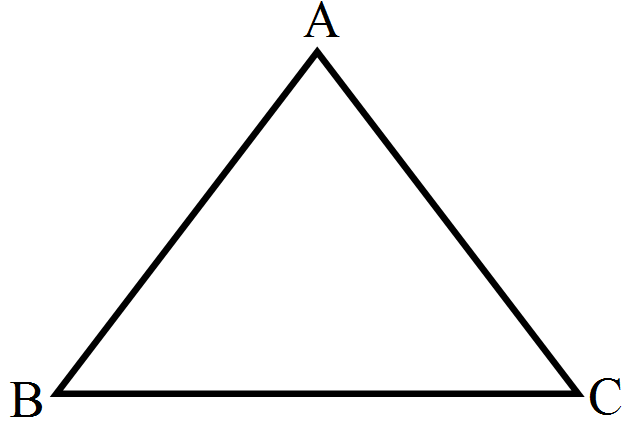
In a $\triangle\text{ABC},$ if $\angle\text{A}=120^\circ$ and $\text{AB}=\text{AC}.$ Find $\angle\text{A}$ and $\angle\text{C}.$
Answer

Consider a $\triangle\text{ABC}.$

Given Mat $\angle\text{A}=120^\circ$ and $\text{AB}=\text{AC}$ and given
to find $\angle\text{B}$ and $\angle\text{C}.$
We can observe that $\triangle\text{ABC}$ is an isosceles triangle since $\text{AB}=\text{AC}$
$\angle\text{B}=\angle\text{C}$ (i)
[Angles opposite to equal sides are equal]
We know that sum of angles in a triangle is equal to 180°
$\Rightarrow\angle\text{A}+\angle\text{B}+\angle\text{C}=180^\circ$
$\Rightarrow\angle\text{A}+\angle\text{B}+\angle\text{B}=180^\circ$
$\Rightarrow120^\circ+2\angle\text{B}=180^\circ$
$\Rightarrow2\angle\text{B}=180^\circ-120^\circ$
$\Rightarrow\angle\text{B}=\angle\text{C}=30^\circ$

Need a full question paper?

Generate a complete, print-ready paper with questions like this in minutes — across 16+ boards, with answer keys.
Start Generating Free

Similar questions

The time taken, in seconds, to solve a problem by each of 25 pupils is as follows:
16, 20, 26, 27, 28, 30, 33, 37, 38, 40, 42, 43, 46, 46, 46, 48, 49, 50, 53, 58, 59, 60, 64, 52, 20
  1. Construct a frequency distribution for these data, using a class interval of 10 seconds.
  2. Draw a histogram to represent the frequency distribution.
BM and CN are perpendiculars to a line passing through the vertex A of triangle ABC. If L is the mid-point of BC, prove that LM = LN.
Prove that the line joining the mid-points of the diagonals of a trapezium is parallel to the parallel sides of the trapezium.
Each edge of a cube is increased by 50%. Find the percentage increase in the surface area of the cube.
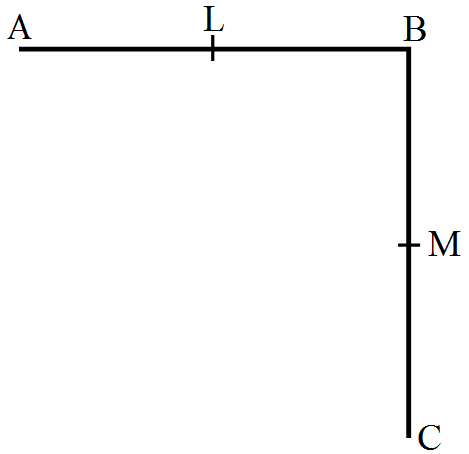
In the given figure, L and M are the mid-points of AB and BC respectively.

  1. If AB = BC, prove that AL = MC.
  2. If BL = BM, prove that AB = BC.
Hint:
  1. $\text{AB}=\text{BC}\Rightarrow\frac{1}{2}\text{AB}=\frac{1}{2}\text{BC}\Rightarrow\text{AL}=\text{MC}.$
  2. $\text{BL}=\text{BM}\Rightarrow2\text{BL}=2\text{BM}\Rightarrow\text{AB}=\text{BC}.$
O is a point in the interior of a square ABCD such that OAB is an equilateral triangle. Show that ΔOCD is an isosceles triangle.
Simplify:
$\frac{2+\sqrt{3}}{2-\sqrt{3}}+\frac{2-\sqrt{3}}{2+\sqrt{3}}+\frac{\sqrt{3}-1}{\sqrt{3}+1}$
Prove that each angle of an equilateral triangle is 60°.
Circles are described on the sides of a triangle as diameters. Proved that the circle on any two sides intersect each other on the third side (or third side produced).
An equilateral triangle of side 9cm is inscribed in a circle. Find the radius of the circle.