Question
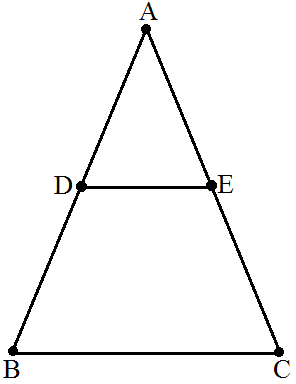
In a $\triangle\text{ABC, D}$ and $E$ are points on the sides $AB$ and $AC$ respectively. For the following cases show that $DE || BC:$
$AD = 5.7\ cm, BD = 9.5\ cm, AE = 3.3\ cm$ and $EC = 5.5\ cm.$
Answer


We have,
$DE || BC$
We have, $AD = 5.7\ cm, BD = 9.5\ cm, AE = 3.3\ cm$ and $EC = 5.5\ cm$
Now $\frac{\text{AD}}{\text{BD}}=\frac{5.7}{9.5}=\frac{57}{95}$
$\Rightarrow\frac{\text{AD}}{\text{BD}}=\frac{3}{5}$
And $\frac{\text{AE}}{\text{EC}}=\frac{3.3}{5.5}=\frac{33}{55}$
$\Rightarrow\frac{\text{AE}}{\text{EC}}=\frac{3}{5}$
Thus $DE$ divides sides $AB$ and $AC$ of $\triangle\text{ABC}$ in the same ratio.Therefore, by the converse of basic proportionality theorem. We have $DE || BC.$

Need a full question paper?

Generate a complete, print-ready paper with questions like this in minutes — across 16+ boards, with answer keys.

Start Generating Free

Similar questions

A cone, a hemisphere and a cylinder stand on equal bases and have the same height. Show that their volumes are in the ratio $1 : 2 : 3.$
A vessel is in the form of a hemispherical bowl surmounted by a hollow cylinder. The diameter of the hemisphere is $21\ cm$ and the total height of the vesel is $14.5\ cm$. find its capacity.
Solve the following equations by using the method of completing the square:
$ x^2-4 x+1=0 $
$O$ is any point inside a rectangle $ABCD$ see Fig. Prove that $OB^2 + OD^2 = OA^2 + OC^2$
.
Prove the following trigonometric identities.
$\frac{1+\sin\theta}{\cos\theta}+\frac{\cos\theta}{1+\sin\theta}=2\sec\theta$
Find the values of $y$ for which the distance between the points $P(2, -3)$ and $Q(10, y)$ is $10$ units.
A bag contains $8$ red, $6$ white and $4$ black balls. A ball is drawn at random from the bag. Find the probability that the drawn ball is:
  1. Red or white.
  2. Not black.
  3. Neither white nor black.
Find the smallest number which leaves remainders $8$ and $12$ when divided by $28$ and $32$ respectively.
$15$ pastries and $12$ biscuit packets have been donated for a school fete. These are to be packed in several smaller identical boxes with the same number of pastries and biscuit packets in each. How many biscuit packets and how many pastries will each box contain$?$
In $\triangle\text{ABC, PQ}$ is a line segment intersecting $AB$ at $P$ and $AC$ at $Q$ such that $PQ || BC$ and $PQ$ divides $\triangle\text{ABC}$ into two parts equal in area. Find $\frac{\text{BP}}{\text{AB}}.$