Question
In a $\triangle\text{ABC},$ if $\text{AB}=\text{AC}$ and $\angle\text{B}=70^\circ.$ Find $\angle\text{A}.$

Answer

In a $\triangle\text{ABC},$ if $\text{AB}=\text{AC}$ and $\angle\text{B}=70^\circ$ Since, $\text{AB}=\text{AC }\triangle\text{ABC}$ is an isosceles triangle$\angle\text{B}=\angle\text{C}$ [Angles opposite to equal sides are equal]
$\angle\text{B}=\angle\text{C}=70^\circ$
And also, Sum of angles in a triangle = 180°$\angle\text{A}+\angle\text{B}+\angle\text{C}=180^\circ$
$\angle\text{A}+70^\circ+70^\circ=180^\circ$
$\angle\text{A}=180^\circ-140^\circ$
$\angle\text{A}=40^\circ$

Need a full question paper?

Generate a complete, print-ready paper with questions like this in minutes — across 16+ boards, with answer keys.
Start Generating Free

Similar questions

A sphere of radius 5cm is immersed in water filled in a cylinder, the level of water rises $\frac{5}{3}$cm. Find the radius of the cylinder.
A cylindrical container with diameter of base 56cm contains sufficient water to submerge a rectangular solid of iron with dimensions 32cm × 22cm × 14cm. Find the rise in the level of the water when the solid is completely submerged.
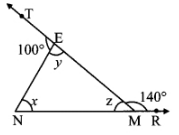
In the adjoining figure, measures of some angles are given. Using the measures, find the values of x, y, z.

Image

Factorize the following expressions:
$(a + b)^3 - 8(a - b)^3$
Diagonals $PR$ and $QS$ of a rhombus $\text PQRS$ are $20\ cm$ and $48\ cm$ respectively. Find the length of side $PQ$.
In the following, using the remainder theorem, find the remainder when f(x) is divided by g(x) and verify the by actual division:$\text{f(x)}=3\text{x}^4+2\text{x}^3-\frac{\text{x}^3}{3}-\frac{\text{x}}{9}+\frac{2}{27},$ $\text{g(x)}=\text{x}+\frac{2}{3}$
If the bisectors of the base angles of a triangle enclose an angle of 135°, prove that the triangle is a right angle.
In triangles ABC and CDE, if AC = CE, BC = CD, $\angle\text{A}=60^\circ,\angle\text{C}=30^\circ$ and $\angle\text{D}=90^\circ.$ Are two triangles congruent?
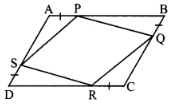
In the adjoining figure, if points P, Q, R, S are on the sides of parallelogram such that AP = BQ = CR = DS, then prove that □PQRS is a parallelogram.

Image
Given: □ABCD is a parallelogram.
AP = BQ = CR = DS
To prove: □PQRS is a parallelogram.

Find the area of an isosceles triangle having the base x cm and one side y cm.