MCQ
In a triclinic crystal system
  • $a \ne b \ne c$, $\alpha \ne \beta \ne \gamma $
  • B
    $a = b = c$, $\alpha \ne \beta \ne \gamma $
  • C
    $a \ne b \ne c$, $\alpha \ne \beta = \gamma $
  • D
    $a = b \ne c$, $\alpha = \beta = \gamma $

Answer

Correct option: A.
$a \ne b \ne c$, $\alpha \ne \beta \ne \gamma $
a
(a)In a triclinic crystal $a \neq b \neq c$  and $\neq$ $\alpha$ $\neq$ $\beta$$\neq$$\gamma$$90°$

Need a full question paper?

Generate a complete, print-ready paper with questions like this in minutes — across 16+ boards, with answer keys.
Start Generating Free

Similar questions

The equivalent inductance of two inductances is 2.4 henry when connected in parallel and 10 henry when connected in series. The difference between the two inductances is
Continuous spectrum is not due to
A telephonic communication service is working at carrier frequency of $10\ GHz$. Only $10\%$ of it is utilized for transmission. How many telephonic channels can be transmitted simultaneously if each channel requires a bandwidth of $5\ kHz?$
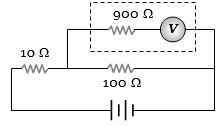
The potential difference across the $100\,\Omega$ resistance in the following circuit is measured by a voltmeter of $900 \,\Omega$ resistance. The percentage error made in reading the potential difference is
The hysteresis cycle for the material of permanent magnet is:
A deuteron and an alpha particle having equal kinetic energy enter perpendicular into a magnetic field. Let $r_{d}$ and $r_{\alpha}$ be their respective radii of circular path. The value of $\frac{r_{d}}{r_{\alpha}}$ is equal to
The breakdown in a reverse biased $p-n$ junction diode is more likely to occur due to
Ten $60 \,W , 220 \,V$ bulbs are connected in series to $220 \,V$ supply. Power consumed in the circuit is ......... $W$
In $NPN$ transistor, $10^{10}$ electrons enters in emitter region in $10^{-6}$ sec. If $2\%$ electrons are lost in base region then collector current and current amplification factor ($\beta$) respectively are
A beam of electrons of energy $E$ scatters from a target having atomic spacing of $1\, A$. The first maximum intensity occurs at $\theta=60^{\circ} .$ Then $E$ (in $eV )$ is$......$

(Planck constant $h =6.64 \times 10^{-34}\, Js$ $1 \,eV =1.6 \times 10^{-19}\,J$, electron mass $\left. m =9.1 \times 10^{-31}\, kg \right)$