MCQ
In a triode amplifier, the value of maximum gain is equal to
  • A
    Half the amplification factor
  • Amplification factor
  • C
    Twice the amplification factor
  • D
    Infinity

Answer

Correct option: B.
Amplification factor
b
(b)The maximum voltage gain $(Av)max = $ $\mu$
(Which is obtained when $RL = $ $\infty$).

Need a full question paper?

Generate a complete, print-ready paper with questions like this in minutes — across 16+ boards, with answer keys.
Start Generating Free

Similar questions

A series LCR circuit with inductance $10\,H$, capacitance $10\,\mu F$, resistance $50\,\Omega$ is connected to an ac source of voltage, $V=200 \sin (100 t)$ volt. If the resonant frequency of the LCR circuit is $\nu_{0}$ and the frequency of the ac source is $v$, then:
A particle of mass $m$ having negative charge $q$ move along an ellipse around a fixed positive charge $Q$ so that its maximum and minimum distances from fixed charge are equal to $r_1$ and $r_2$ respectively. The angular momentum $L$ of this particle is
Two identical short bar magnets, each having magnetic moment $M$ are placed a distance of $2d$ apart with axes perpendicular to each other in a horizontal plane. The magnetic induction at a point midway between them is 
Two ions have equal masses but one is singly$-$ionised and the other is doubly$-$ionised. They are projected from the same place in a uniform magnetic field with the same velocity perpendicular to the field.
Nuclear fission was discovered by
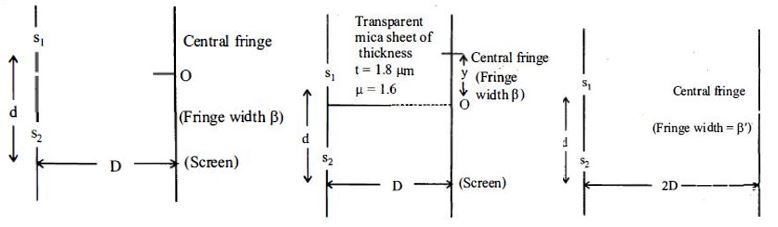
Using monochromatic light of wavelength $\lambda $, an experimentalist sets up the Young 's double slit experiment in three ways as shown. If she observes that $y = \beta '$, the wavelength of light used is.....$nm$
A moving coil galvanometer is based on the:
The work functions for sodium and copper are $2eV$ and $4eV$. Which of them is suitable for a photocell with $4000 Å$ light
A current flows in a conductor from east to west. The direction of the magnetic field at a points above the conductor is .....
The velocity of photons is proportional to (where $\nu=$ frequency)