MCQ
In a turbulent flow, the velocity of the liquid molecules in contact with the walls of the tube is
  • A
    Zero
  • B
    Maximum
  • C
    Equal to critical velocity
  • May have any value

Answer

Correct option: D.
May have any value
d
(d) Turbulent flow is a fluid motion with particle trajectories varying randomly in time, in which irregular fluctuations of velocity, pressure and other parameters arise. since turbulence is a property of the flow rather than a physical characteristic of the liquid, an energy source for maintaining turbulence is required in each case, where such flow is realized. Turbulence may be generated by the work either of shear stresses (friction) in the main (mean) flow, i.e., in the presence of mean velocity gradients (a shear flow), or of mass (buoyant, magnetic) forces.

In near$-$wall flows (i.e., boundary layer, as well as tube and channel flows), turbulence generates in the region of the greatest near$-$wall velocity gradients throughout the flow extent. The turbulent flow is much more capable for transfering momentum, heat and suspended particles, and for propagation of chemical reactions than is laminar flow.

Hence, in a turbulent flow, the velocity of the liquid molecules in contact with the walls of the tube is may have any value.

Need a full question paper?

Generate a complete, print-ready paper with questions like this in minutes — across 16+ boards, with answer keys.
Start Generating Free

Similar questions

$Assertion :$ The velocity of flow of a liquid is smaller when pressure is larger and vice-versa.
$Reason :$ According to Bernoulli’s theorem, for the stream line flow of an ideal liquid, the total energy per unit mass remains constant.
The apparent weight of the body, when it is travelling upwards with an acceleration of $2m/{s^2}$ and mass is $10\, kg,$ will be ......... $N$
A steel wire can sustain $100\,kg$ weight without breaking. If the wire is cut into two equal parts, each part can sustain a weight of ......... $kg$
A small asteroid is orbiting around the sun in a circular orbit of radius $r_0$ with speed $v_0$. A rocket is launched from the asteroid with speed $v=\alpha v_0$, where $v$ is the speed relative to the sun. The highest value of $\alpha$ for which the rocket will remain bound to the solar system is (ignoring gravity due to the asteroid and eff ects of other planets)
If heat is added at constant volume, $6300\,\,J$ of heat are required to raise the temperature of an ideal gas by $150\,\,K$. If instead, heat is added at constant pressure, $8800$ joules are required for the same temperature change. When the temperature of the gas changes by $300\,\,K$, the internal energy of the gas changes by ..... $J$
Two travelling waves ${y_1} = A\sin [k(x - c\,t)]$ and ${y_2} = A\sin [k(x + c\,t)]$ are superimposed on string. The distance between adjacent nodes is
Two waves are propagating along a taut string that coincides with the $x-$axis. The first wave has the wave function $y_1 = A cos [k(x - vt)]$ and the second has the wave function $y = A cos [k(x + vt) + \phi ]$.
If $C_p$ and $C_v$ denote the specific heats of nitrogen per unit mass at constant pressure and constant volume respectively, then
This question has Statement $1$ and Statement $2$ .Of the four choices given after the Statements, choose the one that best describes the two Statements.
Statement $1$ : Bats emitting ultrasonic waves can detect the location of a prey by hearing the waves reflected from it.
Statement $2$ : When the source and the detector are moving, the frequency of reflected waves is changed
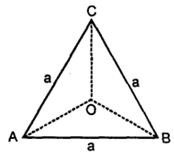
$ABC$ is an equilateral triangle. Length of each side is $a$ and centroid is point $O$. Find If $|\overrightarrow{A B}+\overrightarrow{B C}+\overrightarrow{A C}|=n a$ then $n =$ ?