Question

In a two slit experiment with monochromatic light fringes are obtained on a screen placed at some distance from the sits. If the screen is moved by 5   towards the slits, the change in fringe width is 3 . If separation between the slits is , the wavelength of light used is

(a) 6000 Å

(b) 5000 Å

(c) 3000 Å

(d) 4500 Å

Answer

(a) 6000 Å

Need a full question paper?

Generate a complete, print-ready paper with questions like this in minutes — across 16+ boards, with answer keys.

Start Generating Free

Similar questions

By properly combining two prisms made of different materials, it is possible to:
  1. Have dispersion without average deviation.
  2. Have deviation without dispersion.
  3. Have both dispersion and average deviation.
  4. Have neither dispersion nor average deviation.

The contribution in the total current flowing through a semiconductor due to electrons and holes are   and   respectively. If the drift velocity of electrons is   times that of holes at this temperature, then the ratio of concentration of electrons and holes is

(a) 6 : 5

(b) 5 : 6

(c) 3 : 2

(d) 2 : 3

A simple microscope has:

Which one of the series of hydrogen spectrum is in the visible region

(a) Lyman series

(b) Balmer series

(c) Paschen series

(d) Bracket series

Two small spheres each having the charge +Q are suspended by insulating threads of length L from a hook. This arrangement is taken in space where there is no gravitational effect, then the angle between the two suspensions and the tension in each will be

(a) 180°,  

(b) 90°

(c) 180°,  

(d) 180°,  

Select the correct alternative, The angle between the normal and refracted ray is called:

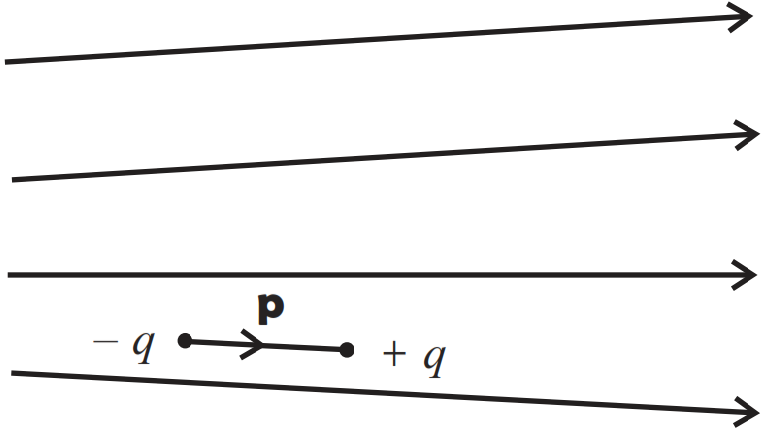
Figure shows electric field lines in which an electric dipole p is placed as shown. Which of the following statements is correct?

The activity of a radioactive sample

(a) Can be increased by heating it

(b) Is independent of physical parameter

(c) Cannot be increased by any method

(d) Both (b) and (c)

The ability of an optical instruments to show the images of two adjacent point objects as separate is called:
How does retarding potential vary with the frequency of light causing photoelectric effect?