MCQ
In a wave, the path difference corresponding to a phase difference of $f$ is
  • A
    $\frac{\pi}{2 \lambda} \emptyset$
  • B
    $\frac{\pi}{\lambda} \emptyset$
  • $\frac{\lambda}{2 \pi} \emptyset$
  • D
    $\frac{\lambda}{\pi} \emptyset$

Answer

Correct option: C.
$\frac{\lambda}{2 \pi} \emptyset$

Need a full question paper?

Generate a complete, print-ready paper with questions like this in minutes — across 16+ boards, with answer keys.
Start Generating Free

Similar questions

The critical angle between an equilateral prism and air is 45°. If the incident ray is perpendicular to the refracting surface, then(a) After deviation it will emerge from the second refracting surface(b) It is totally reflected on the second surface and emerges out perpendicularly from third surface in air(c) It is totally reflected from the second and third refracting surfaces and finally emerges out from the first surface(d) It is totally reflected from all the three sides of prism and never emerges out


The bulk modulus and tbe density of water are greater than those of air. With this much of information, we can say that velocity of sound in air:
  1. Is larger than its value in water.
  2. Is smaller than its value in water.
  3. Is equal to its value in water.
  4. Cannot be compared with its value in water.
The shortest wavelength in the Lyman series of hydrogen spectrum is 912 Å corresponding to a photon energy of 13.6 eV. The shortest wavelength in the Balmer series is about(a) 3648 Å(b) 8208 Å(c) 1228 Å(d) 6566 Å
       
On a glass plate a light wave is incident at an angle of $60^\circ .$ If the reflected and the refracted waves are mutually perpendicular, the refractive index of material is
Two small spheres each carrying a charge q are placed r metre apart. If one of the spheres is taken around the other one in a circular path of radius r, the work done will be equal to(a) Force between them × r (b) Force between them × 2πr (c) Force between them /2πr (d) Zero
   
   
The path of a refracted ray of light in a prism is parallel to the base of the prism only when the(a) Light is of a particular wavelength(b) Ray is incident normally at one face(c) Ray undergoes minimum deviation(d) Prism is made of a particular type of glass


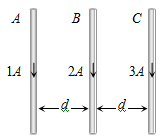
There long straight wires $A, B$ and $C$ are carrying current as shown figure. Then the resultant force on $B$ is directed $.....$
If $l_2$ and $l_2$ be the size of the images respectively for the two positions of lens in the displacement method, then the size of the object is given by
Two parallel plates separated by a distance of 5 mm are kept at a potential difference of $50 V$ . A particle of mass $10^{-15} kg$ and charge $10^{-11} C$ enters in it with a velocity $10^7 m / s$. The acceleration of the particle will be
By photoelectric effect, Einstein, proved