In a Wheatstone’s bridge all the four arms have equal resistance $R$. If the resistance of the galvanometer arm is also $R$, the equivalent resistance of the combination as seen by the battery is
AIPMT 2003, Easy
Download our app for free and get started
(b) As bridge is in balanced condition, no current will flow through $BD.$
$R_{1}=R_{A B}+R_{B C}$
$=R+R=2 R$
$R_{2}=R_{A D}+R_{C D}=R+R=2 R$
Also, $R_{1}$ and $R_{2}$ are in parallel combination
Hence, equivalent resistance between $A$ and $C$ will be
$R_{e q}=\frac{R_{1} R_{2}}{R_{1}+R_{2}}=\frac{4 R^{2}}{4 R}=R$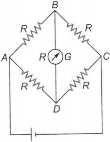

Download our appand get started for free
Experience the future of education. Simply download our apps or reach out to us for more information. Let's shape the future of learning together!No signup needed.*
Similar Questions
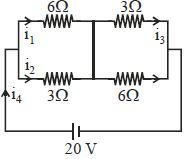
- 1View SolutionDiagram shows a circuit diagram choose incorrect statement
- 2An electrical bulb rated $220\,V , 100\,W$, is connected in series with another bulb rated $220\,V$, $60\,W$.If the voltage across combination is $220\,V$, the power consumed by the $100\,W$ bulb will be about $........... W$View Solution
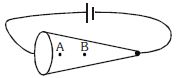
- 3View SolutionSuppose a current carrying wire has a cross-sectional area that, gradually become smaller along the wire, has the shape of a very long cone as shown in figure. Choose the correct statement
- 4Masses of $3$ wires of same metal are in the ratio $1 : 2 : 3$ and their lengths are in the ratio $3 : 2 : 1$. The electrical resistances are in ratioView Solution
- 5A battery has $e.m.f.$ $4\, V$ and internal resistance $r$. When this battery is connected to an external resistance of $2\, ohms$, a current of $1\, amp$. flows in the circuit. How much current will flow if the terminals of the battery are connected directly .......... $amp$View Solution
- 6A metallic block has no potential difference applied across it, then the mean velocity of free electrons is $T$ = absolute temperature of the block)View Solution
- 7View SolutionWhich of the following statement is false
- 8Two wires $A$ and $B$ of same material and mass have their lengths in the ratio $1 : 2$. On connecting them to the same source, the rate of heat dissipation in $B$ is found to be $5\,W$. The rate of heat dissipation in $A$ is............ $W$View Solution
- 9A cell of $emf\;4\,V$ and internal resistance $0.5\,\Omega$ is connected to a $7.5\,\Omega$ external resistance. The terminal potential difference of the cell is $.....\,V$.View Solution
- 10A resistance of $2 \Omega$ is comnected across one gap of a metre-bridge (the length of the wire is $100 \mathrm{~cm}$ ) and an unknown resistance, greater than $2 \Omega$, is connected across the other gap. When these resistance are interchanged, the balance point shifts by $20 \mathrm{~cm}$. Neglecting any corrections, the unknown resistance isView Solution