Question
In a Young's double slit experiment $\lambda=500\text{nm},$ d = 1.0mm and D = 1.0m. Find the minimum distance from the central maximum for which the intensity is half of the maximum intensity.

Answer

Given that, $D = 1m, d = 1mm = 10^{-3}m$, $\lambda=500\text{nm}=5\times10^{-7}\text{m}$ For intensity to be half the maximum intensity.$\text{y}=\frac{\lambda\text{D}}{4\text{d}}$
$\Rightarrow\text{y}=\frac{5\times10^{-7}\times1}{4\times10^{-3}}\Rightarrow\text{y}=1.25\times10^{-4}\text{m}.$

Need a full question paper?

Generate a complete, print-ready paper with questions like this in minutes — across 16+ boards, with answer keys.
Start Generating Free

Similar questions

The velocity of a particle is $v=5+2\left(a_1+a_2 t\right)$ where $a_1$ and $a_2$ are constants and $t$ is the time. What is the acceleration of the particle?
Why is steel more elastic than rubber?
What is the Young’s modulus for a perfect rigid body?
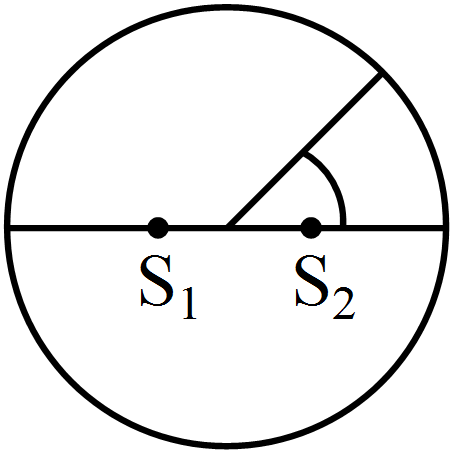
Figure, shows two coherent sources $\mathrm{S}_1$ and $\mathrm{S}_2$ which emit sound of wavelength $\boldsymbol{\lambda}$ in phase. The separation between the sources is $3 \lambda$. A circular wire of large radius is placed in such a way that $S_1 S_2$ lies in its plane and the middle point of $\mathrm{S}_1 \mathrm{~S}_2$ is at the centre of the wire. Find the angular positions $\theta$ on the wire for which constructive interference takes place.
Estimate the fraction of molecular volume to the actual volume occupied by oxygen gas at STP. Given the radius of oxygen molecule as $3\mathring{\text{A}}.$
The frequency of a tunning fork is given by $n=\frac{1}{2 l} \sqrt{\frac{T}{m}}$. Here resonance length is $l$, tension generated due to weight is $T$ and mass of unit length of wire is $m$. Check the correctness of this formula by dimensional method.
It is known that polishing a surface beyond a certain limit increases the frictional force rather than decreasing it. Explain.
What is the Young’s modulus for a perfect rigid body?
The pressure of a gas changes linearly with volume from $\text{10kPa, 200cc}$ to $\text{50kPa, 50cc}$.
  1. Calculate the work done by the gas.
  2. If no heat is supplied or extracted from the gas, what is the change in the internal energy of the gas?
State few important uses of the phenomenon of beats.