MCQ
In a Young’s double slit experiment, the source illuminating the slits is changed from blue to violet. The width of the fringes
  • A
     Increases
  •  Decreases
  • C
     Becomes unequal
  • D
     Remains constant

Answer

Correct option: B.
 Decreases
 Decreases

Need a full question paper?

Generate a complete, print-ready paper with questions like this in minutes — across 16+ boards, with answer keys.
Start Generating Free

Similar questions

The radius of curvature of convex surface of a thin plano-convex lens is 15 cm and refractive index of its material is 1.6. The power of the lens will be
In a situation the contact force by a rough horizontal surface on a body placed on it has constant magnitude. If the angle between this force and the vertical is decreased, the frictional force between the surface and the body will:
Assertion : If the temperature of a semiconductor is increased then it's resistance decreases.
Reason : The energy gap between conduction band and valence band is very small
A particle is projected in a plane perpendicular to a uniform magnetic field. The area bounded by the path described by the particle is proportional to:
A metal conductor of length 1m rotates vertically about one of its ends at angular velocity 5 radians per second. If the horizontal component of earth's magnetic field is $0.2\times 10^{-4}$T, then the e.m.f. developed between the two ends of the conductor is
A beam of parallel rays is brought to a focus by a plano-convex lens. A thin concave lens of the same focal length is joined to the first lens. The effect of this is
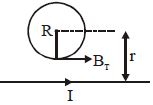
In following diagram there is a straight wire carrying a current $I.$ Consider a circular path with radius $(R)$ near it. It $\vec B_T$ is the tangential component of magnetic field then find the value of integral $\int {{{\vec B}_T}.\overrightarrow {dl} } $
Particle nature and wave nature of electromagnetic waves and electrons can be shown by
If the magnetic field of a plane electromagnetic wave is given by (The speed of light $ = 3 \times {10^8}\,m/s$ )

$B = 100 \times {10^{ - 6}}\,\sin \,\left[ {2\pi  \times 2 \times {{10}^{15}}\,\left( {t - \frac{x}{c}} \right)} \right]$ 

then the maximum electric field associated with it is

Both the nucleus and the atom of some element are in their respective first excited states. They get de-excited by emitting photons of wavelengths $\lambda _N,\,\lambda _A$  respectively. The ratio $\frac{{{\lambda _N}}}{{{\lambda _A}}}$  is closest to