Question
In a Young's double slit experiment using monochromatic light, the fringe pattern shifts by a certain distance on the screen when a mica sheet of refractive index 1.6 and thickness 1.964 micron (1 micron = 10-6m) is introduced in the path of one of the interfering waves. The mica sheet is then removed and the distance between the screen and the slits is doubled. It is found that the distance between the successive maxima now is the same as the observed fringe-shift upon the introduction of the mica sheet. Calculate the wavelength of the monochromatic light used in the experiment.

Answer

In the given Young’s double slit experiment,

$\mu=1.6,$ t = 1.964 micron = 1.964 × 10⁻⁶m

We know, number of fringes shifted $=\frac{(\mu-1)\text{t}}{\lambda}$

So, the corresponding shift = No.of fringes shifted × fringe width

$=\frac{(\mu-1)\text{t}}{\lambda}\times\frac{\lambda\text{D}}{\text{d}}=\frac{(\mu-1)\text{tD}}{\text{d}}\ ...(1)$

Again, when the distance between the screen and the slits is doubled,

Fringe width $=\frac{\lambda(2\text{D})}{\text{d}}\ ...(2)$

From (1) and (2), $\frac{(\mu-1)\text{tD}}{\text{d}}=\frac{\lambda(2\text{D})}{\text{d}}$

$\Rightarrow\lambda=\frac{(\mu-1)\text{t}}{\lambda}$

$=\frac{(1.6-1)\times(1.964)\times10^{-6}}{2}=589.2\times10^{-9}=589.2\text{nm}.$

Need a full question paper?

Generate a complete, print-ready paper with questions like this in minutes — across 16+ boards, with answer keys.

Start Generating Free

Similar questions

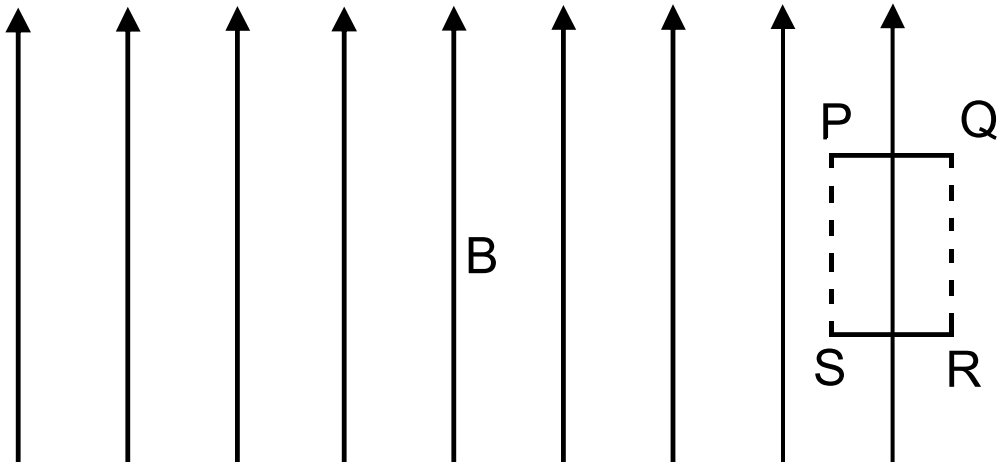
Sometimes we show an idealised magnetic field which is uniform in a given region and falls to zero abruptly. One such field is represented in figure. Using Ampere's law over the path PQRS, show that such a field is not possible.

  1. Find the radius of the circular orbit of a satellite moving with an angular speed equal to the angular speed of earth's rotation.
  2. If the satellite is directly above the north pole at some instant, find the time it takes to come over the equatorial plane. Mass of the earth = 6 × 1024kg.
Figure shows a charge array known as an electric quadrupole. For a point on the axis of the quadrupole, obtain the dependence of potential on r for r/a >> 1, and contrast your results with thatdue to an electric dipole, and an electric monopole (i.e., a single charge).

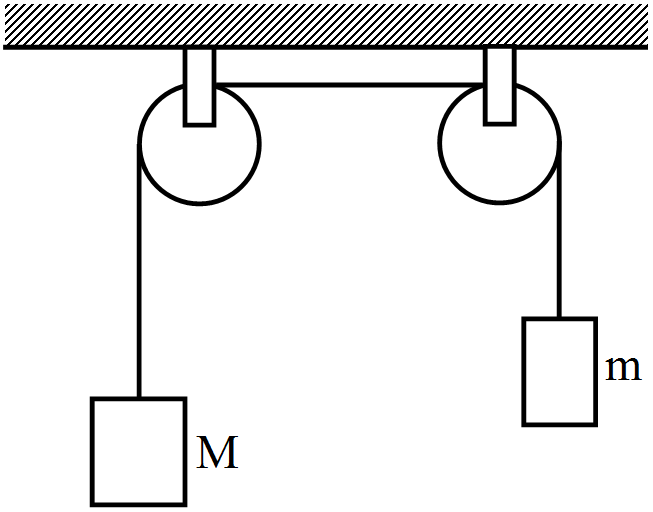
The pulleys in figure are identical, each having a radius R and moment of inertia I. Find the acceleration of the block M.

An electric field is uniform, and in the positive $x$ direction for positive $x$, and uniform with the same magnitude but in the negative $x$ direction for negative $x$. It is given that $E =200 \hat{ i } N / C$ for $x>0$ and $E =-200 \hat{ i } N / C$ for $x<0$. A right circular cylinder of length $20 cm$ and radius $5 cm$ has its centre at the origin and its axis along the $x$-axis so that one face is at $x=+10 cm$ and the other is at $x=-10 cm$ (Fig. 1.25). (a) What is the net outward flux through each flat face? (b) What is the flux through the side of the cylinder? (c) What is the net outward flux through the cylinder? (d) What is the net charge inside the cylinder?
A particle having mass 10g oscillates according to the equation $\text{x}=(2.0\text{cm})\sin\big[(100\text{s}^{-1})\text{t}+\frac{\pi}{6}\big].$ Find (a) the amplitude, the time period and the spring constant (b) the position, the velocity and the acceleration at t = 0.
An object 1.5 cm in size is placed on the side of the convex lens in the arrangement (a) above. The distance between the object and the convex lens is 40 cm. Determine the magnification produced by the two-lens system, and the size of the image.
Can $\text{L}_\alpha$ X-ray of one material have shorter wavelength than $\text{K}_\alpha$ X-ray of another?
A 4µF capacitor is charged by a 200V supply. It is then disconnected from the supply, and is connected to another uncharged 2µF capacitor. How much electrostatic energy of the first capacitor is lost in the form of heat and electromagnetic radiation?
Define induction coefficient. Explain the phenomenon of mutual inductance with the help of an experiment. Obtain an expression for mutual inductance coefficient of two solenoids and prove that $M=\sqrt{L_1 L_2}$.