Question
In a Young's double slit interference experiment the fringe pattern is observed on a screen placed at a distance D from the slits. The slits are separated by a distance d and are illuminated by monochromatic light of wavelength $\lambda$. Find the distance from the central point where the intensity falls to,
  1. Half the maximum.
  2. One fourth of the maximum.

Answer

  1. When intensity is half the maximum $\frac{\text{I}}{\text{I}_\text{max}}=\frac{1}{2}$

$\Rightarrow\frac{4\text{a}^2\cos^2\big(\frac{\phi}{2}\big)}{4\text{a}^2}=\frac{1}{2}$

$\Rightarrow\cos^2\Big(\frac{\phi}{2}\Big)=\frac{1}{2}\Rightarrow\cos\Big(\frac{\phi}{2}\Big)=\frac{1}{\sqrt{2}}$

$\Rightarrow\frac{\phi}{2}=\frac{\pi}{4}\Rightarrow\phi=\frac{\pi}{2}$

$\Rightarrow$ Path difference, $\text{x}=\frac{\lambda}{4}$

$\Rightarrow\text{y}=\frac{\text{xD}}{\text{d}}=\frac{\lambda\text{D}}{4\text{d}}$

  1. When intensity is $\frac{1}{4}\text{th}$ of the maximum $\frac{\text{I}}{\text{I}_\text{max}}=\frac{1}{4}$

$\Rightarrow\frac{4\text{a}^2\cos^2\Big(\frac{\phi}{2}\Big)}{4\text{a}^2}=\frac{1}{4}$

$\Rightarrow\cos^2\Big(\frac{\phi}{2}\Big)=\frac{1}{4}\Rightarrow\cos\Big(\frac{\phi}{2}\Big)=\frac{1}{2}$

$\Rightarrow\frac{\phi}{2}=\frac{\pi}{3}\Rightarrow\phi=\frac{2\pi}{3}$

$\Rightarrow$ Path difference, $\text{x}=\frac{\lambda}{3}$

$\Rightarrow\text{y}=\frac{\text{xD}}{\text{d}}=\frac{\lambda\text{D}}{3\text{d}}$
Need a full question paper?

Generate a complete, print-ready paper with questions like this in minutes — across 16+ boards, with answer keys.

Start Generating Free

Similar questions

A particle executes a simple harmonic motion of amplitude 1.0cm along the principal axis of a convex lens of focal length 12cm. The mean position of oscillation is at 20cm from the lens. Find the amplitude of oscillation of the image of the particle.
A 5mm high pin is placed at a distance of 15cm from a convex lens of focal length 10cm. A second lens of focal length 5cm is placed 40cm from the first lens and 55cm from the pin. Find
  1. The position of the final image.
  2. Its nature.
  3. Its size.
Consider the situation of the previous problem. Suppose the block of mass m1 is pulled by a constant force F1 and the other block is pulled by a constant force F2. Find the maximum elongation that the spring will suffer.
A pendulum bob of mass 80mg and carrying a charge of 2 × 10-8C is at rest in a uniform, horizontal electric field of 20kVm-1. Find the tension in the thread.
Define the capacitance of a capacitor. Obtain an expression for the capacitance of a parallel plate capacitor. And explain on what factors the does capacitance depend?
The property of diamagnetism is said to be present in all materials. Then, why are some materials paramagnetic or ferromagnetic?
A capacitor of capacitance C is given a charge Q. At t = 0, it is connected to an uncharged capacitor of equal capacitance through a resistance R. Find the charge on the second capacitor as a function of time.
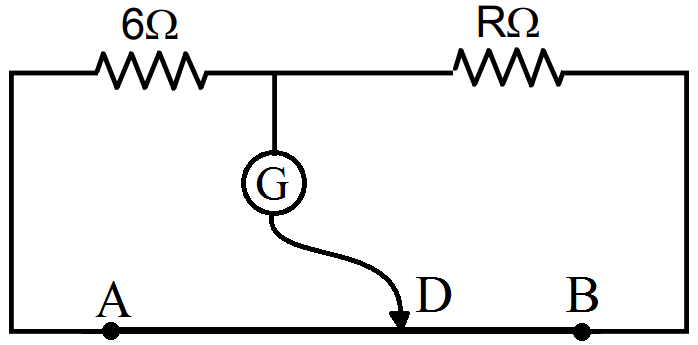
The potentiometer wire AB shown in figure. is 50cm long. When AD = 30cm, no deflection occurs in the galvanometer. Find R.

A thin lens made of a material of refractive index $\mu_2$ has a medium of refractive index $\mu_1$ on one side and a medium of refractive index $\mu_3$ on the other side. The lens is biconvex and the two radii of curvature have equal magnitude R. A beam of light travelling parallel to the principal axis is incident on the lens. Where will the image be formed if the beam is incident from:
  1. The medium $\mu_1$
  2. From the medium $\mu_3?$
The equation of motion of a particle started at t = 0 is given by $\text{x}=5\sin\big(20\text{t}+\frac{\pi}{3}\big)$ where x is in centimetre and t in second. When does the particle.
  1. First come to rest.
  2. First have zero acceleration.
  3. First have maximum speed?