MCQ
In a zener diode, break down occurs in reverse bias due to
  • A
    Impactionisation
  • Internal field emission
  • C
    High doping concentration
  • D
    All of these

Answer

Correct option: B.
Internal field emission
b
(b)

Need a full question paper?

Generate a complete, print-ready paper with questions like this in minutes — across 16+ boards, with answer keys.
Start Generating Free

Similar questions

An electron and a proton are at a distance of $1\,{\mathop A\limits^o }$. The moment of this dipole will be $(C × m)$
$3.8$ days is the half-life period of a sample. After how many days, the sample will become $\frac{{1}}{{8}} \, th$ of the original substance
Two equal forces ($P$ each) act at a point inclined to each other at an angle of $120^°$. The magnitude of their resultant is
An electron has mass $9 \times {10^{ - 31}}\,kg$ and charge $1.6 \times {10^{ - 19}}C$ is moving with a velocity of ${10^6}\,m/s$, enters a region where magnetic field exists. If it describes a circle of radius $0.10\, m$, the intensity of magnetic field must be
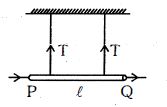
A conducting bar $PQ$ of length $l$ carrying current $I$ is suspended from a rigid support as shown in figure. A uniform magnetic field $B$ perpendicular to $PQ$ and directed away from the reader (inside the plane) is applied. If the mass of the bar is $M$ the tension in each string is
Consider two physical quantities A and B related to each other as $E=\frac{B-x^2}{A t}$ where $E, x$ and $t$ have dimensions of energy, length and time respectively. The dimension of $A B$ is
The relation between time ' $t$ ' and distance ' $x$ ' is $t=$ $\alpha x^2+\beta x$, where $\alpha$ and $\beta$ are constants. The relation between acceleration $(a)$ and velocity $(v)$ is:
When a potential difference $V$ is applied across a wire of resistance $R$, it dissipates energy at a rate $W$. If the wire is cut into two halves and these halves are connected mutually parallel across the same supply, the same supply, the energy dissipation rate will become:
A vertical mass spring system executes simple harmonic oscillations with a period of $2\,s$. A quantity of this system which exhibits simple harmonic variation with a period  of $1\, sec$ is
In photoelectric effect if the intensity of light is doubled then maximum kinetic energy of photoelectrons will become