MCQ
In a zener diode, break down occurs in reverse bias due to
  • A
    Impactionisation
  • Internal field emission
  • C
    High doping concentration
  • D
    All of these

Answer

Correct option: B.
Internal field emission
b
(b)

Need a full question paper?

Generate a complete, print-ready paper with questions like this in minutes — across 16+ boards, with answer keys.
Start Generating Free

Similar questions

Radioactivity is:
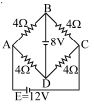
The given figure shows $a$ network of resistances and $a$ battery. Identify the correct statement $(s)$
A circular coil of radius $8.0 \,{cm}$ and $20$ turns is rotated about its vertical diameter with an angular speed of $50\, {rad} {s}^{-1}$ in a uniform horizontal magnetic field of $3.0 \times 10^{-2}\, {T}$. The maximum $emf$ induced the coil will be $\ldots \ldots \ldots \times 10^{-2}$ $volt$ (rounded off to the nearest integer)
The rate of radioactive disintegration at an instant for a radioactive sample of half life $2.2 \times 10^9 \;s$ is $10^{10}\; s ^{-1}$. The number of radioactive atoms in that sample at that instant is,
A thin convex lens of refractive index $1.5$ has a focal length of $15\, cm$ in air. When the lens is placed in liquid of refractive index $4/3$ , its focal length will be......$cm$
A $36 \,\Omega$ galvanometer is shunted by resistance of $4\,\Omega$. The percentage of the total current, which passes through the galvanometer is
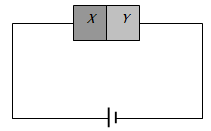
A semiconductor X is made by doping a germanium crystal with arsenic (Z = 33). A second semiconductor Y is made by doping germanium with indium (Z = 49). The two are joined end to end and connected to a battery as shown. Which of the following statements is correct
A potentiometer wire of length $1\,m$ and resistance $10\,\Omega$ is connected in series with a cell of $emf$ $2\,V$ with internal resistance $1 \,\Omega$ and a resistance box including a resistance $R$. If potential difference between the ends of the wire is $1\, mV$, the value of $R$ is ............. $\Omega $
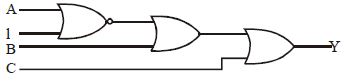
The expression for $Y$ in the following circuit is
The activity of a sample is $64 × 10^{-5}\, Ci.$ Its half-life is $3\, days$. The activity will become $5 × 10^{-6}\, Ci$ after .........$days$