MCQ
In accordance with Newton's third law of motion
  • A
    Action and reaction never balance each other
  • B
    For appearance of action and reaction, physical contact is not necessary
  • C
    This law is applicable whether the bodies are at rest or they are in motion
  • All of these

Answer

Correct option: D.
All of these
d
(d)

$(1)$ Action and reaction act on the different bodies.

$(2)$ Example : Gravitational force, coulomb force

$(3)$ $3rd$ law is irrespective of the state of motion

Need a full question paper?

Generate a complete, print-ready paper with questions like this in minutes — across 16+ boards, with answer keys.

Start Generating Free

Similar questions

The quantity on which the rise of liquid in capillary tube does not depend upon is
If force $\vec{F}=3 \hat{i}+4 \hat{j}-2 \hat{k}$ acts on a particle having position vector $2 \hat{i}+\hat{j}+2 \hat{k}$ then, the torque about the origin will be
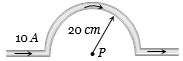
A current of $10\,A$ is passing through a long wire which has semicircular loop of the radius $20\,cm$ as shown in the figure. Magnetic field produced at the centre of the loop is
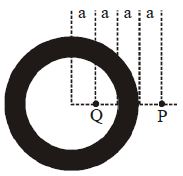
A solid uncharged conducting sphere has radius $3a$ contains a hollowed spherical region of radius $2a$. A point charge $+Q$ is placed at a position a distance a from the common center of the spheres. What is the magnitude of the electric field at the position $r = 4a$ from the center of the spheres as marked in the figure by $P?$ $\left( {k = \frac{1}{{4\pi { \in _0}}}} \right)$
In a radioactive substance at $t = 0$, the number of atoms is $8 \times {10^4}$. Its half life period is $3$ years. The number of atoms $1 \times {10^4}$ will remain after interval ...........$years$
If the sum of the heights of transmitting and receiving antennas in the line of sight of communication is fixed at $160\, {m}$, then the maximum range of LOS communication is $....{km}$

(Take radius of Earth $=6400\, {km}$ )

Two waves of intensity $ I $ undergo Interference. The maximum intensity obtained is
A bullet of mass $4\,g$ is fired horizontally with a speed of $300\,m/s$ into $0.8\,kg$ block of wood at rest on a table. If the coefficient of friction between the block and the table is $0.3,$ how far will the block slide approximately?
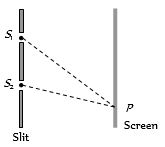
In a Young’s double slit experimental arrangement shown here, if a mica sheet of thickness $t$ and refractive index $\mu $ is placed in front of the slit ${S_1},$ then the path difference $({S_1}P - {S_2}P)$
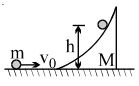
A particle of mass $m$ moving horizontally with $v_0$ strikes $a$ smooth wedge of mass $M$, as shown in figure. After collision, the ball starts moving up the inclined face of the wedge and rises to $a$ height $h$. When the particle has risen to $a$ height $h$ on the wedge, then choose the correct alternative $(s)$