MCQ
In acidic medium, equivalent weight of ${K_2}C{r_2}{O_7}$ $(mol.\,\,wt.\, = M)$ is
- A$M/3$
- B$M/4$
- ✓$M/6$
- D$M/2$
${\text{Equivalent}}\,\,{\text{weight}}\,\,{\text{of }}{K_2}C{r_2}{O_7}$
$ = \frac{{{\text{Molecular}}\,\,{\text{Mass}}}}{6}$$ = \frac{{294.2}}{6} = \frac{M}{6}$.
Generate a complete, print-ready paper with questions like this in minutes — across 16+ boards, with answer keys.
$Br_{2(l)} + Cl_{2(g)} \rightarrow 2BrCl_{(g)}$
are $30\ kJ\ mol^{-1}$ and $105\ J\ K^{-1} mol^{-1}$ respectively. The temperature at which the reaction will be in equilibrium is ............... $\mathrm{K}$
$\mathrm{NaCl}+\mathrm{K}_{2} \mathrm{Cr}_{2} \mathrm{O}_{7}+\mathrm{H}_{2} \mathrm{SO}_{4}(\mathrm{Conc} .) \rightarrow(\mathrm{A})+$ Side products
$(\mathrm{A})+\mathrm{NaOH} \rightarrow(\mathrm{B})+$ side product
$(\mathrm{B})+\mathrm{H}_{2} \mathrm{SO}_{4}(\mathrm{dilute})+\mathrm{H}_{2} \mathrm{O}_{2} \rightarrow(\mathrm{C})+$ Side product
The sum of the total number of atoms in one molecule each of $(A), (B)$ and $(C)$ is
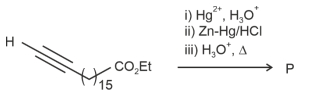
Major product in the above reaction is