MCQ
In an alternating current circuit, the phase difference between current I and voltage is $\phi$ then the wattlen component of current will be :
  • A
    $I cos \phi$
  • B
    $I tan \phi$
  • $I sin \phi$
  • D
    $I cos \phi$

Answer

Correct option: C.
$I sin \phi$
C

Need a full question paper?

Generate a complete, print-ready paper with questions like this in minutes — across 16+ boards, with answer keys.
Start Generating Free

Similar questions

Nuclear fusion is common to the pair(a) Thermonuclear reactor, uranium based nuclear reactor(b) Energy production in sun, uranium based nuclear reactor(c) Energy production in sun, hydrogen bomb(d) Disintegration of heavy nuclei, hydrogen bomb


The ratio of kinetic energy to the total energy of an electron in a Bohr orbit of the hydrogen atom is:
The self-inductance of a solenoid is L. Keeping the length and area same, the number of turns in the coil is increased to two times. The self-inductance of the solenoid will now be-
A player with $3 m$ long iron rod runs towards east with a speed of $30 \ km/hr.$ Horizontal component of earth's magnetic field is $4\times 10^{-5} \mathrm{wb} / \mathrm{m}^2$.. If he is running with rod in horizontal and vertical positions, then the potential difference induced between the two ends of the rod in two cases will be
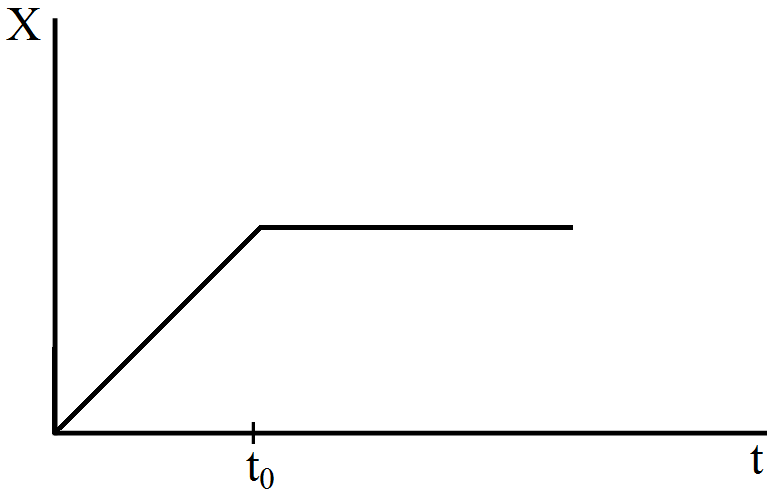
Figure shows the displacement-time graph of a particle moving on the $X-$axis.
  1. The particle is continuously going in positive $x$ direction.
  2. The particle is at rest.
  3. The velocity increases up to a time to, and then becomes constant.
  4. The particle moves at a constant velocity up to a time to, and then stops.
A system can be taken from the initial state $p_1, V_1$ to the final state $p_2, V_2$ by two different methods. Let $\Delta\text{Q}$ and $\Delta\text{W}$ represent the heat given to the system and the work done by the system. Which of the following must be the same in both the methods?
Three observers $A, B$ and $C$ measure the speed of light coming from a source to be $vA, 0B$ and $vc.$ The observer $A$ moves towards the source and $C$ moves away from the source at the same speed. The observer $B$ stays stationary. The surrounding space is vacuum everywhere.
Lorentz force is:
In a mean life of a radioactive sample(a) About 1/3 of substance disintegrates(b) About 2/3 of the substance disintegrates(c) About 90% of the substance disintegrates(d) Almost all the substance disintegrates


Two charges of $+1 μ\text{C} +5 μ\text{C}$ are placed 4cm apart, the ratio of the force exerted by both charges on each other will be-