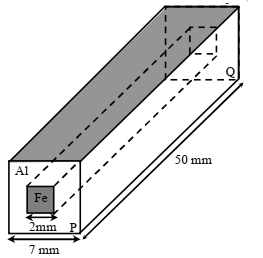
In an aluminium $(A1)$ bar of square cross section, a square hole is drilled and is filled with iron ( $Fe$ ) as shown in the figure. The electrical resistivities of $A 1$ and $Fe$ are $2.7 \times 10^{-8} \ \Omega m$ and $1.0 \times 10^{-7} \ \Omega m$, respectively. The electrical resistance between the two faces $P$ and $Q$ of the composite bar is
IIT 2015, Advanced
Download our app for free and get started
$R_{ F }=\frac{\rho_{ F } \times 50 \times 10^{-3}}{\left(2 \times 10^{-3}\right)^2}=1250 \mu \Omega $
$R_{A l}=\frac{\rho_{A \ell} \times 50 \times 10^{-3}}{(49-4) \times 10^{-6}}=30 \mu \Omega $
$R_{* q}=\frac{1250 \times 30}{1280}=\frac{1875}{64} \mu \Omega$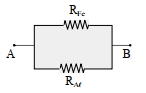

Download our appand get started for free
Experience the future of education. Simply download our apps or reach out to us for more information. Let's shape the future of learning together!No signup needed.*
Similar Questions
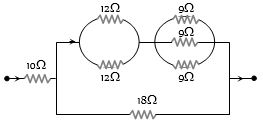
- 1In the following circuit, $18\,\Omega $ resistor develops $2\,J/sec$ due to current flowing through it. The power developed across $10\,\Omega $ resistance is .............. $W$View Solution
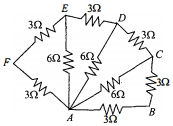
- 2Two electric bulbs have tungsten filament of same length. If one of them gives $60\ W$ and the other $100\ W$ , thenView Solution
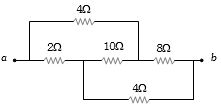
- 3Find the equivalent resistance between the points $a$ and $b$ .......... $\Omega$View Solution
- 4View SolutionAn electric heater kept in vacuum is heated continuously by passing electric current. Its temperature
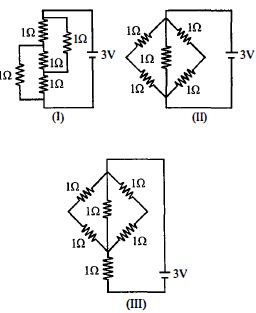
- 5The figure shows three circuits $I, II$ and $III$ which are connected to a $3\,V$ battery. If the powers dissipated by the configurations $I, II$ and $III$ are $P_1 , P_2$ and $P_3$ respectively, thenView Solution
- 6The resistances of the platinum wire of a platinum resistance thermometer at the ice point and steam point are $8 \Omega$ and $10 \Omega$ respectively. After inserting in a hot bath of temperature $400^{\circ} \mathrm{C}$, the resistance of platinum wire is:View Solution
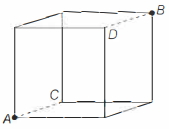
- 7A cube is formed with ten identical resistances $R$ (thick lines) and two shorting wires (dotted lines) along the arms $A C$ and $B D$ as shown in the figure below. Resistance between point $A$ and $B$ is ...........$\Omega$View Solution
- 8A $1\,m$ long wire is broken into two unequal parts $X$ and $Y$ The $X$ part of the wire is streched into another wire $W$. Length of $W$ is twice the length of $X$ and the resistance of $W$ is twice that of $Y$. Find the ratio of length of $X$ and $Y$.View Solution
- 9Four wires $AB,\,\,BC,\,\,CD,\,\,DA$ of resistance $4\, \Omega$ each and a fifth wire $BD$ of resistance $8\, \Omega$ are joined to form a rectangle $ABCD$ of which $BD$ is a diagonal. The effective resistance between the points $A$ and $B$ isView Solution
- 10Six resistors of $3 \;\Omega$ each are connected along the sides of a hexagon and three resistors of $6\; \Omega$ each are connected along $A C, A D$ and $A E$ as shown in the figure. The equivalent resistance between $A$ and $B$ is equal toView Solution