MCQ
In an elastic collision:
  • A
    The initial kinetic energy is equal to the final kinetic energy.
  • B
    The final kinetic energy is less than the initial kinetic energy.
  • C
    The kinetic energy remains constant.
  • D
    The kinetic energy first increases then decreases.
Answer

  1. The initial kinetic energy is equal to the final kinetic energy.

Explanation:

As no energy is lost into heat in an elastic collision, the initial kinetic energy is equal to the final kinetic energy.

Need a full question paper?

Generate a complete, print-ready paper with questions like this in minutes — across 16+ boards, with answer keys.

Start Generating Free

Similar questions

The $SI$ unit of mechanical equivalent of heat is
The escape velocity of a sphere of mass $m$ is given by $(G=$ Universal gravitational constant; $M_e=$ Mass of the earth and $R_e=$ Radius of the earth)
A ball moving with a velocity of $6\, m/s$ strikes an identical stationary ball. After collision each ball moves at an angle of $30^o$ with the original line of motion. What are the speeds of the balls after the collision ?
One car moving on a straight road covers one third of the distance with $20 \,km/hr $ and the rest with $60\, km/hr$. The average speed is..........$km/hr$
A container has $N$ molecules at absolute temperature $T$. If the number of molecules is doubled but kinetic energy in the box remain the same as before, the absolute temperature of the gas is ...........
A projectile is launched at an angle ' $\alpha$ ' with the horizontal with a velocity $20 \; ms ^{-1}$. After $10 s$, its inclination with horizontal is ' $\beta$ '. The value of $\tan \beta$ will be : $\left( g =10 \; ms ^{-2}\right)$
A tank with a small hole at the bottom has been filled with water and kerosene (specific gravity $0.8$). The height of water is $3\,m$ and that of kerosene $2\,m$. When the hole is opened the velocity of fluid coming out from it is nearly ........ $ms^{-1}$ .(take $g\, = 10\, m s^{-2}$ and density of water $= 10^3\, kg\, m^{-3}$)
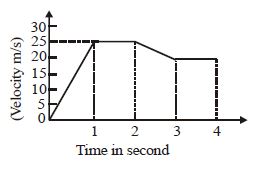
The variation of velocity of particle with time moving along a straight line is illustrated in the following figure. The distance travelled by the particle in four seconds is.......$m$
A body at rest may have
A car is moving at a speed of $40\,m/s$ on a circular track of radius $400\,m.$ This speed is increasing at the rate of $3\,m/s^2.$ The acceleration of car is  ........ $m/s^2$