MCQ
In an electrochemical cell, cathode is:
- AAlways neutral.
- BAlways positive.
- CThe electrode at which reduction takes place.
- DAlways negative.
Explanation:
In an electrochemical cell, cathode is the electrode, at which reduction takes place and electrons are gained by some species.
Anode is the electrode, at which oxidation takes place and the electrons are lost by some species.
Generate a complete, print-ready paper with questions like this in minutes — across 16+ boards, with answer keys.
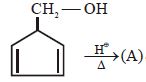
$(A)$ Nucleotide form from nucleoside and phosphate group by ether linkage
$(B)$ In nucleoside, nitrogenous base link with hexose sugar of $DNA$ or $RNA$
$(C)$ $DNA$ and $RNA$ are differ in only nature of sugar
$(D)$ $A = T$ and $C \equiv G$ are hydrogen bond between nitrogenous base

$Ag\left( s \right)\left| {AgBr\left( s \right)\,\left| {B{r^ - }\left( {0.01\,M} \right)} \right|\,\left| {{I^ - }\left( {0.02\,M} \right)} \right|\,AgI\left( s \right)} \right|Ag\left( s \right)$
the correct information is
[Given : $K_{sp}\,\left( {AgBr} \right) = 4 \times {10^{ - 13}}$ ,
$K_{sp}\,\left( {AgI} \right)$ $ = 8 \times {10^{ - 17}},\frac{{2.303\,RT}}{F} = 0.06\,V,\,\log \,2 = 0.3]$