Question
In an equilateral triangle with side a, prove that area $=\frac{\sqrt{3}}{4}\text{a}^2.$
Answer


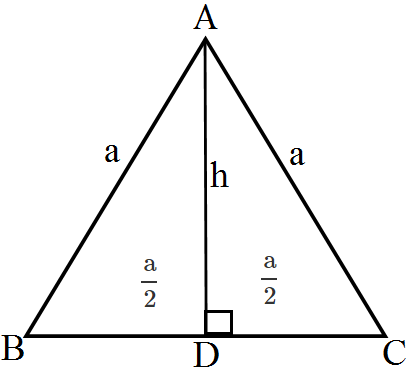
Let ABC be the equilateral triangle with each side equal to a.
Let AD be the altitude from A, meeting BC at D.
Therefore, D is the midpoint of BC.
Let AD be h.
Applying Pythagoras theorem in right-angled triangle ABD, we have:
$AB^2 = AD^2 + BD^2$
$\Rightarrow\text{a}^2=\text{h}^2+\big(\frac{\text{a}}{2}\big)^2$
$\Rightarrow\text{h}^2=\text{a}^2-\frac{\text{a}}{4}=\frac{3}{4}\text{a}^2$
$\Rightarrow\text{h}=\frac{\sqrt{3}}{2}\text{a}$
Therefore,
Area of triangle $\text{ABC}=\frac{1}{2}\times\text{base}\times\text{height}=\frac{1}{2}\times\text{a}\times\frac{\sqrt{3}}{2}\text{a}$
$=\frac{\sqrt{3}}{4}\text{a}^2$
This completes the proof.

Need a full question paper?

Generate a complete, print-ready paper with questions like this in minutes — across 16+ boards, with answer keys.

Start Generating Free

Similar questions

One card is drawn from a well-shuffled deck of 52 cards. Find the probability of drawing:
  1. An ace.
  2. A '4' cf spades.
  3. A '9' of a black suit.
  4. A red king.
Calculate the missing frequency from the following distribution, it being given that the median of the distribution is 24.
Class 0-10 10-20 20-30 30-40 40-50
Frequency 5 25 ? 18 7
A two-digit number is 3 more than 4 times the sum of its digits. If 8 is added to the number, the digits are reversed. Find the number.
50 students enter for a school javelin throw competition. The distance (in metres) thrown are recorded below:
Distance (in m)
0-20
20-40
40-60
60-80
80-100
Number of students
6
11
17
12
4
  1. Construct a cumulative frequency table.
  2. Draw a cumulative frequency curve (less than type) and calculate the median distance thrown by using this curve.
  3. Calculate the median distance by using the formula for median.
  4. Are the median distance calculated in (ii) and (iii) same?
Find the area of a right-angled triangle, the radius of whose circumcircle measure 8cm and the altitude drawn to the hypotenuse measures 6cm.
If $(\tan\theta+\sin\theta)=\text{m}$ and $(\tan\theta-\sin\theta)=\text{n},$ prove that $\big(\text{m}^2-\text{n}^2\big)^2=16\text{mn}.$
Two identical cubes each of volume $64cm^3 $are joined together end to end. What is the surface area of the resulting cuboid?
A bag contains 24 balls of which x are red, 2x are white and 3x are blue. A ball is selected at random. What is the probability that it is:
  1. not red?
  2. white?
If $\sec\theta+\tan\theta=\text{p},$ prove that:$\tan\theta=\frac12\Big(\text{p}+\frac{1}{\text{p}}\Big)$
Show graphically that each of the following given systems of equations is inconsistent, i.e., has no solutions:
x - 2y = 6, 3x - 6y = 0