MCQ
In an experiment input characteristics are shown for $CE$ configuration $n-p-n$ transistor for different output voltages. here
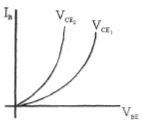
  • $V_{CE_1} > V_{CE_2}$
  • B
    $V_{CE_1} = V_{CE_2}$
  • C
    $V_{CE_1} < V_{CE_2}$
  • D
    None of these

Answer

Correct option: A.
$V_{CE_1} > V_{CE_2}$
a
$V_{CE_2} < V_{CE_1}$

Need a full question paper?

Generate a complete, print-ready paper with questions like this in minutes — across 16+ boards, with answer keys.
Start Generating Free

Similar questions

The relay satellite transmits the $T.V.$ programme continuously from one part of the world to another because its
For a body moving with relativistic speed, if the velocity is doubled, then
A bob of mass $10\, kg$ is attached to wire $0.3\, m$ long. Its breaking stress is $4.8 \times 10^7 N/m^2$. The area of cross section of the wire is $10^{-6} m^2$. The maximum angular velocity with which it can be rotated in a horizontal circle ....... $rad/sec$
Heat is being supplied at a constant rate to a sphere of ice which is melting at the rate of $0.1 \,\,gm/sec$. It melts completely in $100\,\,sec$. The rate of rise of temperature thereafter will be ........$^oC/\sec$ (Assume no loss of heat.)
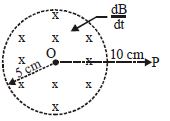
Magnetic fleld changing at the rate of $4\,T/sec$ in a circular region of $5\, cm$ radius.  The value of induced electric field at a point $'P'$, which is $10\, cm$ distance away  from the centre $'O'$ of region is .....$V/m$
A particle is moving in a straight line and passes through a point $O$ with a velocity of $6\;m{s^{ - 1}}.$ The particle moves with a constant retardation of $2\;m{s^{ - 2}}\;$ for $4$ s and there after moves with constant velocity. How long after leaving $O$ does the particle return to $O$..........$s$
A vector $\vec Q$ which has a magnitude of $8$ is added to the vector $\vec P$ which lies along $x-$ axis. The resultant of two vectors lies along $y-$ axis and has magnitude twice that of  $\vec P$. The magnitude of is $\vec P$
A block of mass $1\, kg$ is at rest on a horizontal table. The coefficient of static friction  between the block and the table is $0.5.$ The magnitude of the force acting upwards at  an angle of $60^o$ from the horizontal that will just start the block moving is
Speed of recession of galaxy is proportional to it's distance
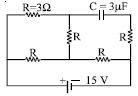
In the circuit shown, the cell is ideal, with $emf$ $=$ $15$ $V$. Each resistance is of $3 $ $\Omega$ . The potential difference across the capacitor is.....$V$