Question
In an experiment, it was found that the string vibrates in $3$ loops when 'x' g was as mass of placed on the scale pan. What must be placed on the pan to make the string vibrate in 9 loops?

Answer

Frequency of vibration of string vibrating in P loops is
$\text{v}=\frac{\text{P}}{2\text{l}}\sqrt{\frac{\text{T}}{\mu}}$
$TP^2 =$ constant
$\text{T}_1\text{P}^2_1=\text{T}_2\text{P}^2_2$
$\text{T}_2=\text{T}_1\Big(\frac{\text{P}_1}{\text{P}_2}\Big)^2$
$=\text{x}\Big(\frac{3}{9}\Big)^2=\text{x}\frac{9}{81}=\frac{\text{x}}{9}$

Need a full question paper?

Generate a complete, print-ready paper with questions like this in minutes — across 16+ boards, with answer keys.
Start Generating Free

Similar questions

Derive an expression for the potential energy of an elastic stretched spring.
Two small balls A and B, each of mass m, are joined rigidly by a light horizontal rod of length L. The rod is clamped at the centre in such a way that it can rotate freely about a vertical axis through its centre. The system is rotated with an angular speed w about the axis. A particle P of mass m kept at rest sticks to the ball A as the ball collides with it. Find the new angular speed of the rod.
A refrigerator has to transfer an average of 263J of heat per second from temperature -10°C to 25°C. Calculate the average power consumed assuming ideal reversible cycle and no other losses.
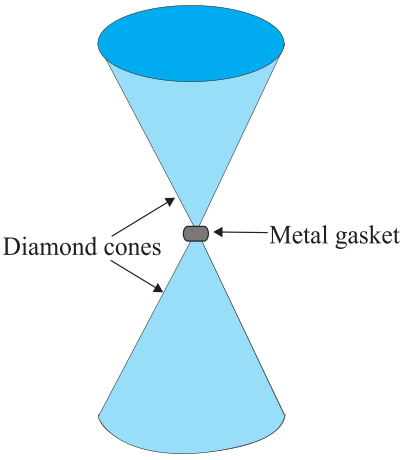
Anvils made of single crystals of diamond, with the shape as shown in Fig., are used to investigate behaviour of materials under very high pressures. Flat faces at the narrow end of the anvil have a diameter of $0.50mm$, and the wide ends are subjected to a compressional force of $50,000N$. What is the pressure at the tip of the anvil?
A rod of length $L$ is placed along the $X-$axis between $x = 0$ and $x = L$. The linear density $($mass$/$ length$) \rho$ of the rod varies with the distance $x$ from the origin as $\rho=\text{a + bx.}$
  1. Find the $SI$ units of $a$ and $b$.
  2. Find the mass of the rod in terms of $a, b$ and $L.$
The magnifying power of a converging lens used as a simple microscope is $\Big(1+\frac{\text{D}}{\text{f}}\Big).$ A compound microscope is a combination of two such converging lenses. Why don't we have magnifying power $\Big(1+\frac{\text{D}}{\text{f}_\text{o}}\Big) \Big(1+\frac{\text{D}}{\text{f}_\text{o}}\Big)?$ In other words, why can the objective not be treated as a simple microscope but the eyepiece can?
A player throws a ball upwards with an initial speed of $29.4m s^{–1}$. Choose the $x = 0m$ and $t = 0s$ to be the location and time of the ball at its highest point, vertically downward direction to be the positive direction of x-axis, and give the signs of position, velocity and acceleration of the ball during its upward, and downward motion.
Calculate the temperature which has same numeral value on celsius and Fahrenheit scale.
The density of a cylindrical rod was measured by using the formula: $\rho=\frac{4\text{m}}{\pi\text{D}^2\text{l}}$
How should one kg of water at 5°C be so divided that one part of it when converted into ice at 0°C, would by this change of state provide a quantity of heat that would be sufficient to vaporize the other part?