Question

In an isolated parallel plate capacitor of capacitance C, the four surface have charges  and  as shown. The potential difference between the plates is
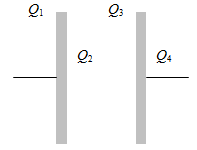
(a)

(b) 

(c)

(d)

Answer

(c)

Need a full question paper?

Generate a complete, print-ready paper with questions like this in minutes — across 16+ boards, with answer keys.

Start Generating Free

Similar questions

Equal potentials are applied on an iron and copper wire of same length.  In order to have the same current flow in the two wires, the ratio r (iron)/r (copper) of their radii must be (Given that specific resistance of iron =  ohm–m and specific resistance of copper =  1.7  ohm-m)

(a) About 1.2

(b) About 2.4

(c) About 3.6

(d) About 4.8

Magnetic induction is a

(a) Scalar quantity

(b) Vector quantity

(c) Both (a) and (b)

(d) None of the above

Current i is carried in a wire of length L. If the wire is turned into a circular coil, the maximum magnitude of torque in a given magnetic field B will be

(a)  

(a)  

(c)  

(d)  

The earth’s magnetic field at a given point is 0.5  . This field is to be annulled by magnetic induction at the center of a circular conducting loop of radius 5.0cm. The current required to be flown in the loop is nearly

(a) 0.2 A

(b) 0.4A

(c) 4A      

(d) 40A

A bar magnet is released from rest along the axis of a very long, vertical copper tube. After some time the magnet:
  1. Will stop in the tube.
  2. Will move with almost content speed.
  3. Will move with an acceleration g.
  4. Will oscillate.
The distinction between conductors, insulators and semiconductors is largely concerned with:
For distance far away from centre of dipole the change in magnitude of electric field with change in distance from the centre of dipole is:

Time period for a magnet is T. If it is divided in four equal parts along its axis and perpendicular to its axis as shown then time period for each part will be

(a) 4T  

(b) T/4

(c) T/2     

(d) T

In Young's double slit experiment how many maximas can be obtained on a screen (including the central maximum) on both sides of the central fringe if λ = 2000 and d = 7000  

(a) 12

(b) 7

(c) 18       

(d) 4

Assertion  :   The 200 W bulbs glows with more brightness then 100 W bulbs.

Reason    : A 100 W bulb has more resistance than a 200 W bulb.

(a) If both assertion and reason are true and the reason is the correct explanation of the assertion.

(b) If both assertion and reason are true but reason is not the correct explanation of the assertion.

(c) If assertion is true but reason is false.

(d) If the assertion and reason both are false.