MCQ
In an isothermal change, an ideal gas obeys
  • Boyle's law
  • B
    Charle's law
  • C
    Gaylussac law
  • D
    None of the above

Answer

Correct option: A.
Boyle's law
a
(a)In isothermal process, compressibility ${E_\theta } = \rho $

Need a full question paper?

Generate a complete, print-ready paper with questions like this in minutes — across 16+ boards, with answer keys.
Start Generating Free

Similar questions

The refractive index of prism is $\mu=\sqrt{3}$ and the ratio of the angle of minimum deviation to the angle of prism is one. The value of angle of prism is$. . . . . .^\circ$.
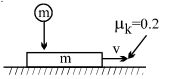
$A$ ball of mass $m$ falls vertically from a height $h$ and collides with $a$ block of equal mass $m$ moving horizontally with $a$ velocity $v$ on $a$ surface. The coefficient of kinetic friction between the block and the surface is $0.2$, while the coefficient of restitution $e$ between the ball and the block is $0.5.$ There is no friction acting between the ball and the block. The velocity of the block decreases by
A proton and an electron both moving with the same velocity $v$ enter into a region of magnetic field directed perpendicular to the velocity of the particles. They will now move in circular orbits such that
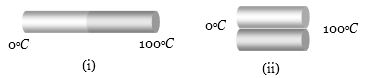
Two identical square rods of metal are welded end to end as shown in figure $(i)$ , $20$ calories of heat flows through it in $4$ minutes. If the rods are welded as shown in figure $(ii)$, the same amount of heat will flow through the rods in ....... $\min.$
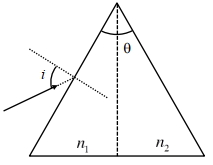
For a prism of prism angle $\theta=60^{\circ}$, the refractive indices of the left half and the right half are, respectively, $n_1$ and $n_2\left(n_2 \geq n_1\right)$ as shown in the figure. The angle of incidence $i$ is chosen such that the incident light rays will have minimum deviation if $n_1=n_2=n=1.5$. For the case of unequal refractive indices, $n_1=n$ and $n_2=n+\Delta n$ (where $\Delta n \ll n$ ), the angle of emergence $e=i+\Delta e$.

Which of the following statement($s$) is (are) correct?

$(A)$ The value of $\Delta e$ (in radians) is greater than that of $\Delta n$

$(B)$ $\Delta e$ is proportional to $\Delta n$

$(C)$ $\Delta e$ lies between 2.0 and 3.0 milliradians, if $\Delta n=2.8 \times 10^{-3}$

$(D)$ $\Delta e$ lies between 1.0 and 1.6 milliradians, if $\Delta n=2.8 \times 10^{-3}$
If a body describes a circular motion under inverse square field, the time taken to complete one revolution $T$ is related to the radius of the circular orbit as
An $AC$ current is given by $I = I_0 + I_1$ $sin\, wt$ then its $rms$ value will be
A ray incident a ${15^o}$ on one refracting surface of a prism of angle ${60^o}$, suffers a deviation of ${55^o}$. What is the angle of emergence
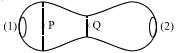
Ametallic conductor of irregular cross-section is as shown in the figure. Aconstant potential difference is applied across the ends $(1)$ and $(2)$. Then :
A particle comes round a circle of radius $1 \,m$ once. The time taken by it is $10 \,sec$. The average velocity of motion is