MCQ
In an isothermal change, an ideal gas obeys
  • Boyle's law
  • B
    Charle's law
  • C
    Gaylussac law
  • D
    None of the above

Answer

Correct option: A.
Boyle's law
a
(a)In isothermal process, compressibility ${E_\theta } = \rho $

Need a full question paper?

Generate a complete, print-ready paper with questions like this in minutes — across 16+ boards, with answer keys.

Start Generating Free

Similar questions

If a piece of ice at $0^{\circ} $ temperature is put into water at $0^{\circ}\text C $temperature, then in ideal condition the ice :
Two gases occupy two containers $A$ and $B$ the gas in $A$, of volume $0.10\,m ^3$, exerts a pressure of $1.40\,MPa$ and that in $B$ of volume $0.15 m ^3$ exerts a pressure $0.7\,MPa$. The two containers are united by a tube of negligible volume and the gases are allowed to intermingle. Then if the temperature remains constant, the final pressure in the container will be (in MPa)
A vernier callipers used by student has $20$ divisions in $1\;cm$ on main scale. $10$ vernier divisions coincide with $9$ main scale divisions. When jaws are closed, zero of main scale is on left of zero of vernier scale and $6\ th$ division of vernier scale coincides with any of main scale divisions. He places a wooden cylinder in between the jaws and measures the length. The zero of vernier scale is on right of $3.20\;cm$ and $8\ th$ vernier division coincides with any main scale division. When he measures thickness of cylinder he finds that zero of vernier scale lies on right of $1.50\;cm$ mark of main scale and $6\ th$ division of vernier scale coincides with any main scale division. The correct values of measured length and diameter are respectively
Keeping the number of moles, volume and temperature the same, which of the following are the same for all ideal gases?
For an adiabatic expansion of an ideal gas, the fractional change in its pressure is equal to (where $\gamma$ is the ratio of specific heats):
Given below are two statements: One is labelled as Assertion $(A)$ and other is labelled as Reason $(R)$.

Assertion $(A)$ : Time period of oscillation of a liquid drop depends on surface tension $(S)$, if density of the liquid is $p$ and radius of the drop is $r$, then $T = k \sqrt{ pr ^{3} / s ^{3 / 2}}$ is dimensionally correct, where $K$ is dimensionless.

Reason $(R)$: Using dimensional analysis we get $R.H.S.$ having different dimension than that of time period.

In the light of above statements, choose the correct answer from the options given below.
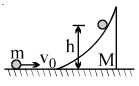
A particle of mass $m$ moving horizontally with $v_0$ strikes $a$ smooth wedge of mass $M$, as shown in figure. After collision, the ball starts moving up the inclined face of the wedge and rises to $a$ height $h$. When the particle has risen to $a$ height $h$ on the wedge, then choose the correct alternative $(s)$
In isothermic process, which statement is wrong
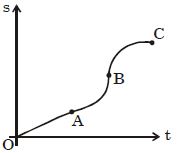
Displacement-time graph of a particle moving in a straight line is as shown in figure. Select the correct alternative
A cylindrical metallic rod in thermal contact with two reservoirs of heat at its two ends conducts an amount of heat $Q$ in time $t$. The metallic rod is melted and the material is formed into a rod of half the radius of the original rod. What is the amount of heat conducted by the new rod, when placed in thermal contact with the two reservoirs in time $t$ ?