MCQ
In an orchestra, the musical sounds of different instruments are distinguished from one another by which of the following characteristics
  • A
    Pitch
  • B
    Loudness
  • Quality
  • D
    Overtones

Answer

Correct option: C.
Quality
c
(c) There are $3$ properties of sound, based on which we can distinguish one sound-note from the other.

They are Loudness, Pitch (or shrillness) and $Quality.$

Loudness of a sound depends on the Amplitude of the sound-wave. Greater the amplitude, louder is the sound.

Pitch or shrillness depends on the frequency. Greater the frequency, shriller is the sound. Quality or Timbre depends on the overtones present in the sound, along with the fundamental note and their amplitudes. Quality is the property by which two sounds may appear different even if they are equally loud and shrill.

Suppose I am playing a note on flute and sitar. Even if both the notes are of same pitch and loudness, they appear different. That is because of difference in quality

Need a full question paper?

Generate a complete, print-ready paper with questions like this in minutes — across 16+ boards, with answer keys.
Start Generating Free

Similar questions

A particle of mass $m$ moves in a one-dimensional potential energy $U(x) = -ax^2 + bx^4,$ where $'a'$ and $'b'$ are positive constants. The angular frequency of small oscillations about the minima of the potential energy is equal to
A particle moves for $8\, seconds$. It first accelerates from rest and then retards to rest. If the retardation be $3\, times$ the acceleration, then time for which it accelerates will be 
A remote-sensing satellite of earth revolves in a circular orbit at a height of $0.25 \times 10^6\, m$ above the surface of earth. If earth's radius is $6.38 \times 10^6\, m$ and $g = 9.8 \,ms^{-2}$, then the orbital speed of the satellite is ...... $kms^{-1}$
A particle moves in a circular path of radius $r$ with speed $v.$ It then increases its speed to $2\,v$ while travelling along the same circular path. The centripetal acceleration of the particle has changed by a factor of
The volume $V$ of a given mass of monoatomic gas changes with temperature $T$ according to the relation $V = KT ^{2 / 3}$. The workdone when temperature changes by $90\, K$ will be $x\,R$. The value of $x$ is $[ R =$ universal gas constant $]$
When an air bubble of radius $r$ rises from the bottom to the surface of a lake, its radius becomes $\frac{{5r}}{4}$.Taking the atmospheric pressure to be equal to $10\,m$ height of water column, the depth of the lake would approximately be ....... $m$ (ignore the surface tension and the effect of temperature)
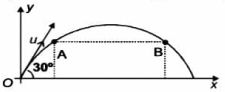
A particle is thrown with a velocity of $u \,m / s$. It passes $A$ and $B$ as shown in figure at time $t_1=1 \,s$ and $t_2=3 \,s$. The value of $u$ is ....... $m / s$ $\left(g=10 \,m / s ^2\right)$
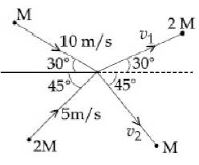
Two particles, of masses $M$ and $2M$, moving as shown, with speeds of $10\, m/s$ and $5\, m/s$, collide elastically at the origin. After the collision, they move along the indicated directions with speeds $v_1$ and $v_2$ respectively. The value of $v_1$ and $v_2$ are nearly
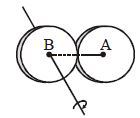
Two thin discs each of mass $M$ and radius $r$ are attached as shown in figure, to form a rigid body. The rotational inertia of this body about an axis perpendicular to the plane of disc $B$ and passing through its centre is
A tuning fork of frequency 512Hz is vibrated with a sonometer wire and 6 beats per second are heard. The beat frequency reduces if the tension in the string is slightly increased. The original frequency of vibration of the string is: