MCQ
In annihilation process, in which an electron and a positron transform into two gamma rays, which property of electric charge is displayed?
  • A
    Additivity of charge.
  • B
    Quantisation of charge.
  • Conservation of charge.
  • D
    Attraction and repulsion.

Answer

Correct option: C.
Conservation of charge.

Need a full question paper?

Generate a complete, print-ready paper with questions like this in minutes — across 16+ boards, with answer keys.

Start Generating Free

Similar questions

Three concentric metallic spherical shells of radii $R, 2R, 3R$, are given charges $Q_1, Q_2, Q_3$, respectively. It is found that the surface charge densities on the outer surfaces of the shells are equal. Then, the ratio of the charges given to the shells, $Q_1 : Q_2 : Q_3$ is
In a uniform electric field, a cube of side $1\ cm$ is placed. The total energy stored in the cube is $8.85\ μJ$ . The electric field is parallel to four of the faces of the cube. The electric flux through any one of the remaining two faces is
$A$ diminished image of an object is to be obtained on a large screen $1\, m$ from it. This can be achieved by
When a metallic surface is illuminated with light of wavelength $\lambda$, the stopping potential is $x$ volt. When the same surface is illuminated by light of wavelength $2 \lambda$, the stopping potential is $\frac{x}{3}$. Threshold wavelength for the metallic surface is ..........
Assertion : If three capacitors of capacitance $C_1 < C_2 < C_3$ are connected in parallel then their equivalent capacitance $C_p > C_s$
Reason :$\frac{1}{C_P}=\frac{1}{C_1}+\frac{1}{C_2}+\frac{1}{C_3}$
In a compound microscope, the magnified virtual image is formed at a distance of $25\, cm$ from the eye-piece. The focal length of its objective lens is $1\, cm .$ If the magnification is $100$ and the tube length of the microscope is $20\, cm ,$ then the focal length of the eye-piece lens (in $cm$ ) is
A medium is said to be dispersive, if
When a metal surface is illuminated by light of wavelength $\lambda$, the stopping potential is $8 \mathrm{~V}$. When the same surface is illuminated by light of wavelength $3 \lambda$, stopping potential is $2 \mathrm{~V}$. The threshold wavelength for this surface is :
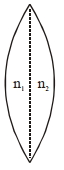
A thin convex lens is made of two materials with refractive indices $n_1$ and $n_2$, as shown in figure. The radius of curvature of the left and right spherical surfaces are equal. $f$ is the focal length of the lens when $n_1=n_2=n$. The focal length is $f+\Delta f$ when $n_1=n$ and $n_2=n+\Delta n$. Assuming $\Delta n \ll$ (n-1) and $1< n <2$, the correct statement(s) is/are :

$(1)$ The relation between $\frac{\Delta f}{f}$ and $\frac{\Delta n}{n}$ remains unchanged if both the convex surfaces are replaced by concave surfaces of the same radius of curvature.

$(2)$ $\left|\frac{\Delta f }{ f }\right|<\left|\frac{\Delta n }{ n }\right|$

$(3)$ For $n =1.5, \Delta n =10^{-3}$ and $f =20 cm$, the value of $|\Delta f |$ will be $0.02 cm$ (round off to $2^{\text {nd }}$ decimal place)

$(4)$ If $\frac{\Delta n }{ n }<0$ then $\frac{\Delta f }{ f }>0$
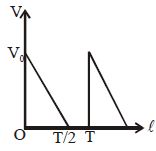
The average value of potential difference $V$ shown in figure is