MCQ
In aqueous solution ______ amines are unexpectedly less basic than the others.
  • A
    Primary
  • B
    Secondary
  • C
    Primary and Secondary
  • D
    Tertiary

Answer

  1. Tertiary

Explanation:

In aqueous solution tertiary amines are unexpectedly less basic than the others.

This is due to steric factor and solvation of ions.

Need a full question paper?

Generate a complete, print-ready paper with questions like this in minutes — across 16+ boards, with answer keys.

Start Generating Free

Similar questions

When $CHCl_3$ is boiled with  $NaOH$ , It gives
Which does not show mutarotation
$3-$ Hydroxybutanal is formed when $X$ reacts with $Y$ in dilute $Z$ solution. What are $X, Y$ and $Z$ ?

$X-Y-Z$

The Henry law constant for dissolution of a gas in aqueous medium is $3 × 10^2$  $atm$. At what partial pressure of the gas, the molality of gas in aqueous solution will be $\frac{5}{9}\,m$.
Out of following isomeric forms of uracil, which one is present in $RNA$ ?
The strongest base among the following is
$p$-Amino- $N, N$-dimethylaniline is added to a strongly acidic solution of ${X}$. The resulting solution is treated with a few drops of aqueous solution of ${Y}$ to yield blue coloration due to the formation of methylene blue. Treatment of the aqueous solution of ${Y}$ with the reagent potassium hexacyanoferrate$(II)$ leads to the formation of an intense blue precipitate. The precipitate dissolves on excess addition of the reagent. Similarly, treatment of the solution of ${Y}$ with the solution of potassium hexacyanoferrate$(III)$ leads to a brown coloration due to the formation of ${Z}$.

$1.$ The compound ${X}$ is

$(A)$ $\mathrm{NaNO}_3$ $(B)$ $\mathrm{NaCl}$ $(C)$ $\mathrm{Na}_2 \mathrm{SO}_4$ $(D)$ $\mathrm{Na}_2 \mathrm{~S}$

$2.$ The compound ${Y}$ is

$(A)$ $\mathrm{MgCl}_2$ $(B)$ $\mathrm{FeCl}_2$ $(C)$ $\mathrm{FeCl}_3$ $(D)$ $\mathrm{ZnCl}_2$

$3.$ The compound ${Z}$ is

$(A)$ $\left.\mathrm{Mg}_2 \mid \mathrm{Fe}(\mathrm{CN})_6\right]$ $(B)$ $\operatorname{Fe}\left[\mathrm{Fe}(\mathrm{CN})_6\right]$

$(C)$ $\mathrm{Fe}_4\left[\mathrm{Fe}(\mathrm{CN})_6\right]_3$ $(D)$ $\mathrm{K}_2 \mathrm{Zn}_3\left[\mathrm{Fe}(\mathrm{CN})_6\right]_2$

Give the answer question $1,2$ and $3.$
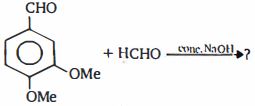
The following reaction gives
How much chlorine will be liberated on passing one ampere current for $30 $ minutes through $ NaCl $ solution
Acetaldehyde and acetone can be distinguished by