Question
In beta decay, an electron (or a positron) is emitted by a nucleus. Does the remaining atom get oppositely charged?

Answer

In beta decay, a neutron from the nucleus is converted to a proton releasing an electron and an antineutrino or a proton is converted to a neutron releasing a positron and a neutrino.
$\beta^-\text{decay:}\text{ n}\rightarrow\text{p + e + }\vec{\text{v}}$
$\beta^+\text{decay:}\text{ p}\rightarrow\text{n + e}^+ + \text{v}$
Since the number of valence electrons present in the parent atom do not change, the remaining atom does not get oppositely charged. Instead, due to a change in the atomic number, there's a formation of a new element.

Need a full question paper?

Generate a complete, print-ready paper with questions like this in minutes — across 16+ boards, with answer keys.
Start Generating Free

Similar questions

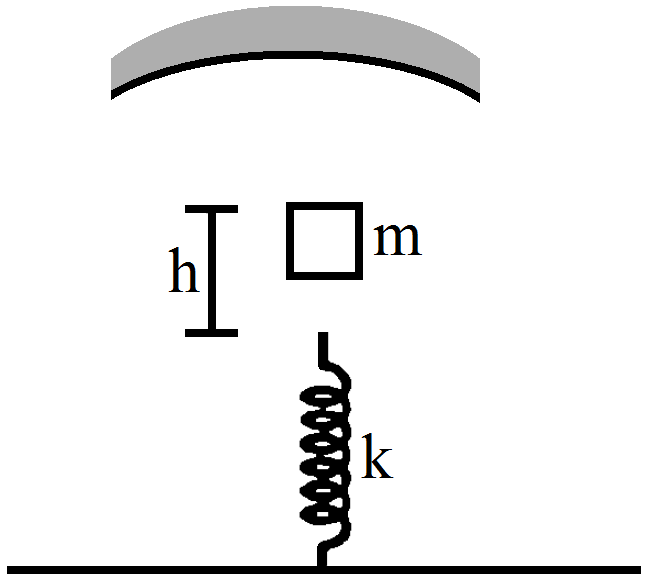
A mass m = 50g is dropped on a vertical spring of spring constant 500N/m from a height h = 10cm as shown in figure. The mass sticks to the spring and executes simple harmonic oscillations after that. A concave mirror of focal length 12cm facing the mass is fixed with its principal axis coinciding with the line of motion of the mass, its pole being at a distance of 30cm from the free end of the spring. Find the length in which the image of the mass oscillates.

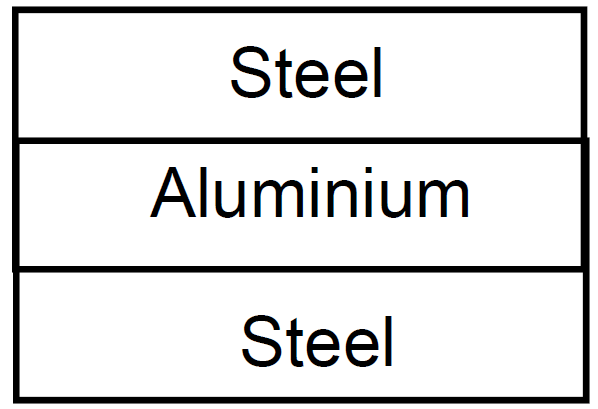
Two steel rods and an aluminium rod of equal length l0 and equal cross section are joined rigidly at their ends as shown in the figure below. All the rods are in a state of zero tension at 0°C. Find the length of the system when the temperature is raised to $\theta$. Coefficient of linear expanaion of aluminium and steel are $\alpha_\text{a}$ and $\alpha_\text{s}$respectively. Young's modulus of aluminium is Ya and of steel is Ys.

Find the charge required to flow through an electrolyte to liberate one atom of.
  1. A monovalent material.
  2. A divalent material.
The gravitational pontential in a region is given by V = (20N/kg) (x + y).
  1. Show that the equation is dimensionally correct.
  2. Find the gravitational field at the point (x, y). Leave your answer in terms of the unit vectors $\overrightarrow{\text{i}},\ \overrightarrow{\text{j}},\ \overrightarrow{\text{k}}.$
  3. Calculate the magnitude of the gravitational force on a particle of mass 500g placed at the origin.
In an intrinsic semiconductor the energy gap Eg is 1.2eV. Its hole mobility is much smaller than electron mobility and independent of temperature. What is the ratio between conductivity at 600K and that at 300K? Assume that the temperature dependence of intrinsic carrier concentration ni is given by,
$\text{n}_{\text{i}}=\text{n}_{\text{0}}\ {\text{exp}}\Big(-\frac{\text{E}_\text{g}}{2{\text{K}_{\text{B}}}{\text{T}}}\Big)$
where n0 is a constant.
A proton projected in a magnetic field of 0.020T travels along a helical path of radius 5.0cm and pitch 20cm. Find the components of the velocity of the proton along and perpendicular to the magnetic field. Take the mass of the proton = 1.6 × 10⁻²⁷kg
Figure shows a cylindrical tube with adiabatic walls and fitted with an adiabatic separator. The separator can be slid into the tube by an external mechanism. An ideal gas $(\gamma=1.5)$ is injected in the two sides at equal pressures and temperatures. The separator remains in equilibrium at the middle. It is now slid to a position where it divides the tube in the ratio 1 : 3. Find the ratio of the temperatures in the two parts of the vessel.

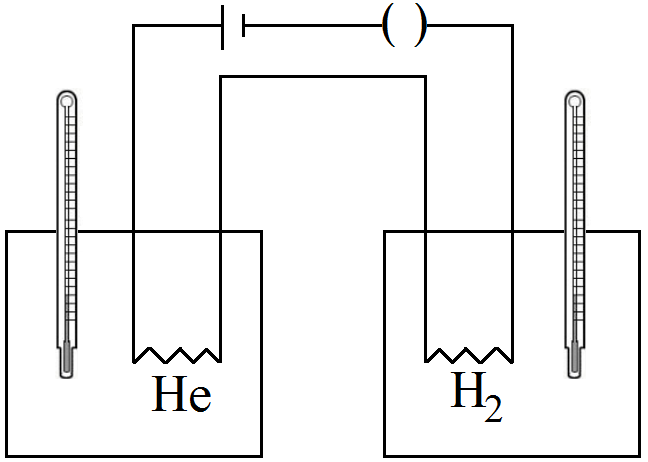
The figure shows two vessels with adiabatic walls, one containing 0.1g of helium $\big(\gamma=1.67,\text{M}=4\text{g-mol}^{-1}\big)$ and the other containing some amount of hydrogen $\big(\gamma=1.4,\text{M}=2\text{g-mol}^{-1}\big).$ Initially, the temperatures of the two gases are equal. The gases are electrically heated for some time during which equal amounts of heat are given to the two gases. It is found that the temperatures rise through the same amount in the two vessels. Calculate the mass of hydrogen.

A body starts slipping down an incline and moves half meter in half second. How long will it take to move the next half meter?
Explain "Electron Theory of Electric Charge".