Question
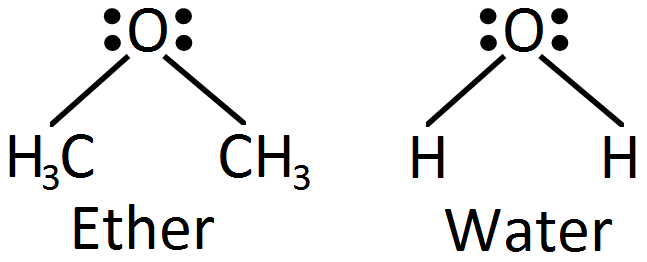
In both water and dimethyl ether oxygen atom is central atom, and has the same hybridisation, yet they have different bond angles. Which one has greater bond angle? Give reason.
Answer

Dimethyl ether will have larger bond angle. There will be more repulsion between bond pairs of $\mathrm{CH}_3$ groups attached in ether than between bond pairs of hydrogen atoms attached to oxygen in water. The carbon of $\mathrm{CH}_3$ in ether is attached to three hydrogen atoms through $\sigma$ bonds and electron pairs of these bonds add to the electronic charge density on carbon atom. Hence, repulsion between two $-\mathrm{CH}_3$ groups will be more than that between two hydrogen atoms.

Need a full question paper?

Generate a complete, print-ready paper with questions like this in minutes — across 16+ boards, with answer keys.

Start Generating Free

Similar questions

  1. Name the metal used in photoelectric cells.
  2. Why diamond is used as an abrasive?
  3. What are allotropes?
What could be the harmful effects of improper management of industrial and domestic solid waste in a city?
  1. The mass of an electron is $9.1 \times 10^{-28}g$. If its K.E. is $3.0 \times 10^{-25}J$, calculate its wave-length in Angstrom. $[h = 6.6 \times 10^{-34}Js]$
  2. What is photoelectric effect?
Predict the dipole moment of
i. a molecule of the type $AX _2$ having a linear geometry.
ii. a molecule of the type $AX _4$ having tetrahedral geometry.
iii. a molecule of the type $AX _2$ having angular geometry.
iv. a molecule of the type $AX _4$ having square planar geometry.
  1. Account for the following:
  1. Boron halides do not dimerise like $BH_3$.
  2. Carbon shows catenation remarkably.
  3. $PbCl_4$ is a good oxidising agent.
  1. Complete the following reactions:
  1. $\text{Na}_{2}\text{B}_{4}\text{O}_{7} + 2\text{HCl} + \text{5H}_{2}\text{O} \xrightarrow{\ \ \ \ \ \ \ \ }$
  2. $\text{B}_{2}\text{H}_{6} + 6\text{NH}_{3} \xrightarrow[\ \ \ \ \ \ ]{\Delta}$
If $4g$ of $NaOH$ dissolves in 36g of $H_2O$, calculate the mole fraction of each component in the solution. Also, determine the molarity of solution (specific gravity of solution is $1g mL^{–1}).$
Express each of the following in SI units,
  1. 14 pound per square inch (atmospheric pressure).
  2. 100 mile per hour.
  3. 5 feet 2 inch.
  4. 150 pound.
Calculate the wavenumber for the longest wavelength transition in the Balmer series of atomic hydrogen.
Write a relation between $\Delta\text{G}$ and Q and define the meaning of each term and answer the following:
  1. Why a reaction proceeds forward when Q < K and no net reaction occurs when Q = K.
  2. Explain the effect of increase in pressure in terms of reaction quotient Q. for the reaction: $\text{CO(g)}+\text{3H}_2\text{(g)}\rightleftharpoons\text{CH}_4\text{(g)}+\text{H}_2\text{O(g)}$
Describe what you need to do in the laboratory to test
i. the law of conservation of mass,
ii. the law of definite proportion
iii. the law of multiple proportions.