MCQ
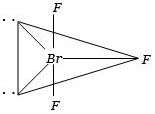
In $Br{F_3}$ molecule,the lone pairs occupy equatorial positions to minimize
  • A
    Lone pair- lone pair repuilsion and lone pair-bond pair repulsion
  • Lone pair- lone pair repulsion only
  • C
    Lone pair- bond pair repulsion only
  • D
    Bond pair- bond pair repulsion only

Answer

Correct option: B.
Lone pair- lone pair repulsion only
(b) Bent $T-$ shaped geometry in which both lone pairs occupy the equatorial position of the trigonal bipyramidal here $({{l}_{p}}-{{l}_{p}})$ repulsion $= 0$

$({{l}_{p}}-{{b}_{p}})$ repulsion $= 4$ and 

$({{b}_{p}}-{{b}_{p}})$ repulsion $= 2$

Need a full question paper?

Generate a complete, print-ready paper with questions like this in minutes — across 16+ boards, with answer keys.

Start Generating Free

Similar questions

Find the moleculer weight of a solid containing $20\%$ by mole of $S$ atoms, whose $400\ g$ provides just sufficient $S$ atoms to produce enough $H_2SO_4$ to neutralise $100\ g\  NaOH$
Molality of $0.8 \ \mathrm{M} \mathrm{H}_2 \mathrm{SO}_4$ solution (density $1.06 \mathrm{~g} \mathrm{~cm}^{-3}$ ) is________ $\times 10^{-3} m$.
Which of the following compounds will show geometrical isomerism
For each of the following pairs of $E_2$ reaction, select the one that occurs with  the greater rate constant.

$(1)$ $C{H_3}C{H_2}C{H_2}Cl + $ $\begin{array}{*{20}{c}}
  {\,\begin{array}{*{20}{c}}
  {\,\,\,\,\,\,\,\,\,\,C{H_3}} \\ 
  {\,\,\,|} 
\end{array}} \\ 
  {C{H_3} - C - {O^ - }} \\ 
  {\,\,\,|} \\ 
  {\,\,\,\,\,\,\,\,\,\,C{H_3}} 
\end{array}$                      $(2)$  $C{H_3}C{H_2}C{H_2}I + $$\begin{array}{*{20}{c}}
  {\,\begin{array}{*{20}{c}}
  {\,\,\,\,\,\,\,\,\,\,C{H_3}} \\ 
  {\,\,\,|} 
\end{array}} \\ 
  {C{H_3} - C - {O^ - }} \\ 
  {\,\,\,|} \\ 
  {\,\,\,\,\,\,\,\,\,\,C{H_3}} 
\end{array}$

$(3)$  $\begin{array}{*{20}{c}}
  {{H_3}C - CH - C{H_3}} \\ 
  {|\,\,\,\,} \\ 
  {Br\,\,\,} 
\end{array}$  $+CH_3O^-$                      $(4)$  $\begin{array}{*{20}{c}}
  {{H_3}C - CH - C{H_3}} \\ 
  {|\,\,\,\,} \\ 
  {Br\,\,\,} 
\end{array}$ $+CH_3S^-$

The set which does not have ambidentate ligand(s) is
Which of the following has the highest dipole moment
Kerosene is a mixture of
Which one of the following orders is correct for the bond dissociation enthalpy of halogen molecules?
Phenol and benzoic acid is distinguished by
in the change ${[Cu({H_2}{O_6})]^{2 + }}\,\xrightarrow{{HCl}}\,{[CuCl{({H_2}O)_5}]^ + }$, the colour changes from