MCQ
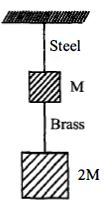
In capillary pressure below the curved surface of water will be
  • A
    Equal to atmospheric
  • B
    Equal to upper side pressure
  • C
    More than upper side pressure
  • Lesser than upper side pressure

Answer

Correct option: D.
Lesser than upper side pressure
d
(d) In capillary pressure below curved surface is less than upper side pressure.

Need a full question paper?

Generate a complete, print-ready paper with questions like this in minutes — across 16+ boards, with answer keys.
Start Generating Free

Similar questions

A solid cylinder of radius $R$ and mass $M$, rolls down on inclined plane without slipping and reaches the bottom with a speed $v$. The speed would be less than $v$ if we use
A soap film is formed on a circular frame. A loop of thread is lying on film. If the film inside the loop is broken, then tension in the thread will be : ($R =$ radius of loop, $T =$ surface tension of liquid)
Two bodies of different masses ${m_a}$ and ${m_b}$ are dropped from two different heights $a$ and $b$. The ratio of the time taken by the two to cover these distances are
A sound wave is passing through air column in the form of compression and rarefaction. In consecutive compressions and rarefactions:
Which of the following statements regarding motion of particle is true?

Match Column $- I$ and Column $- II$ and choose the correct match from the given choices.
Column $- I$ Column $- II$
$(A)$ Root mean square speed of gas molecules $(P)$ $\frac{1}{3} \mathrm{n} m \bar{v}^{2}$
$(B)$ Pressure exerted by ideal gas $(Q)$ $\sqrt{\frac{3 \mathrm{RT}}{\mathrm{M}}}$
$(C)$ Average kinetic energy of a molecule $(R)$ $\frac{5}{2} \mathrm{RT}$
$(D)$ Total internal energy  of $1$ mole of a diatomic gas $(S)$ $\frac{3}{2} \mathrm{k}_{\mathrm{B}} \mathrm{T}$
If the ratio of lengths, radii and Young's moduli of steel and brass wires in the figure are $a, b$ and $c$ respectively, then the corresponding ratio of increase in their lengths is
Force (F) and density (d) are related as $\text{F}=\frac{\alpha}{\beta+\sqrt{\text{d}}}$
Then, the dimensions of a and B are:
Two satellites of masses ${m_1}$ and ${m_2}({m_1} > {m_2})$ are revolving round the earth in circular orbits of radius ${r_1}$ and ${r_2}({r_1} > {r_2})$ respectively. Which of the following statements is true regarding their speeds ${v_1}$ and ${v_2}$ ?
An object of mass $0.5\, {kg}$ is executing simple harmonic motion. Its amplitude is $5\, {cm}$ and time period (T) is $0.2\, {s} .$ What will be the potential energy of the object at an instant $t=\frac{T}{4}$ s starting from mean position. Assume that the initial phase of the oscillation is zero. (In ${J}$)