MCQ
In compound $X$, all the bond angles are exactly ${109^o}28',\,\,X$ is
  • A
    Chloromethane
  • B
    Iodoform
  • Carbon tetrachloride
  • D
    Chloroform

Answer

Correct option: C.
Carbon tetrachloride
(c) Compound is carbontetrachloride because $CC{l_4}$ has $s{p^3}$-hybridization $4$ orbitals giving regular tetrahedron geometry.

In others the geometry is little distorted inspite of $s{p^3}$ hybridization due to different atoms on the vertices of tetrahedron.

Need a full question paper?

Generate a complete, print-ready paper with questions like this in minutes — across 16+ boards, with answer keys.

Start Generating Free

Similar questions

An alkene $A$ on reaction with $\mathrm{O}_{3}$ and $\mathrm{Zn}-\mathrm{H}_{2} \mathrm{O}$ gives propanone and ethanal in equimolar ratio. Addition of $HCl$ to alkene $A$ gives $B$ as the major product. The structure of product $B$ is:
The total number of lone pairs of electrons in $N _2 O _3$ is
The most stable conformation of $n-$ butane is
Which of the following compounds are diprotic
The catalyst used in Raschig's process is
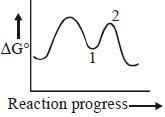
What names apply to chemical species corresponding to locations $1$ and $2$ on this reaction coordinate diagram?

Location $1$ $-$ Location $2$

Chloro compound of Vanadium has only spin magnetic moment of $1.73\, BM$. This Vanadium chloride has the formula
Which one of the following phenols does not give colour when condensed with phthalic anhydride in presence of conc. $\mathrm{H}_{2} \mathrm{SO}_{4} ?$
A pair of stereoisomers might be classified in various ways. Which of the  following statement are true with respect to pairs of stereoisomers?

$(a)$ They might be configurational isomers  $(b)$ They might be diastereomers
$(c)$ They might be constitutional isomers    $(d)$ They might be tautomers
$(e)$ They might be conformational isomers   $(f)$ They might be enantiomers
$(g)$ They might be positional isomers

Match each of the reactions given in Column $I$ with the corresponding product$(s)$ given in Column $II$.
Column $I$ Column $II$
$(A)$ $\mathrm{Cu}+$ dil $\mathrm{HNO}_3$ $(p)$ NO
$(B)$ $\mathrm{Cu}+$ conc $\mathrm{HNO}_3$ $(q)$ $\mathrm{NO}_2$
$(C)$ $\mathrm{Zn}+$ dil $\mathrm{HNO}_3$ $(r)$ $\mathrm{N}_2 \mathrm{O}$
$(D)$ $\mathrm{Zn}+$ conc $\mathrm{HNO}_3$ $(s)$ $\mathrm{Cu}\left(\mathrm{NO}_3\right)_2$
  $(t)$ $ \mathrm{Zn}\left(\mathrm{NO}_3\right)_2$