MCQ
In cyclotron the resonance condition is:
  • A
    The frequency of revolution of charged particle is equal to the frequency of A.C. voltage sources.
  • B
    The frequency of revolution of charged particle is equal to the frequency of applied magnetic field.
  • C
    The frequency of revolution of charged particle is equal to the frequency of rotation of earth.
  • D
    The frequency of revolution of charged particle, frequency of A.C. source and frequency of magnetic field are equal.

Answer

  1. The frequency of revolution of charged particle is equal to the frequency of A.C. voltage sources.

Need a full question paper?

Generate a complete, print-ready paper with questions like this in minutes — across 16+ boards, with answer keys.

Start Generating Free

Similar questions

Mass number is denoted by:

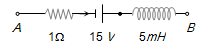
The network shown in the figure is a part of a complete circuit. If at a certain instant the current i is 5 A and is decreasing at the rate of   then   is

(a) 5 V

(b) 10 V

(c) 15 V

(d) 20 V

White light may be considered to be a mixture of waves with l ranging between 3900 Å and 7800 Å. An oil film of thickness 10,000 Å is examined normally by reflected light. If m = 1.4, then the film appears bright for

(a) 4308 Å, 5091 Å, 6222 Å

(b) 4000 Å, 5091 Å, 5600 Å

(c) 4667 Å, 6222 Å, 7000 Å

(d) 4000 Å, 4667 Å, 5600 Å, 7000Å

Which of the following products in a hydrogen atom are independent of the principal quantum number n? The symbols have their usual meanings.

A varying current at the rate of 3 A/s in a coil generates an e.m.f. of 8 mV in a nearby coil. The mutual inductance of the two coils is

(a) 2.66 mH

(b) 2.66  

(c) 2.66 H

(d) 0.266 H

The free electron density is more in .....:

If n drops, each of capacitance C, coalesce to form a single big drop, then the ratio of the energy stored in the big drop to that in each small drop will be

(a) n : 1   

(b) n1/3 : 1

(c) n5/3 : 1

(d) n2 : 1

Which of the following transition will have highest emission wavelength

(a) n = 2 to  n = 1

(b) n = 1 to n = 2

(c) n = 2 to n= 5

(d) n = 5 to n = 2

The amplitude modulated (AM) radio wave bends appreciably round the corners of a 1m × 1m board but the frequency modulated (FM) wave only negligibly bends. If the average wavelengths of AM and FM waves are $\lambda_\text{a}$ and $\lambda_\text{f}:$
Which of the following frequency ranges is used in T.V. broadcasting :