Question
In deriving the single slit diffraction pattern, it was stated that the intensity is zero at angles of $\text{n}\lambda/\text{a}.$ Justify this by suitably dividing the slit to bring out the cancellation.

Answer

Let the slit width 'a' be divided into n equal parts of width 'a' so that,
$\text{a}'=\frac{\text{a}}{\text{n}}$
i.e., a = na'
Then,
$\text{Angle},\ \theta=\frac{\text{n}\lambda}{\text{a}}=\frac{\text{n}\lambda}{\text{na}'}$
$\text{i.e.},\ \theta=\frac{\lambda}{\text{a}'}$
At this derived angle, each slit will make first diffraction minimum. Hence, the resultant intensity for all slits will be zero at an angle of $\frac{\text{n}\lambda}{\text{a}}.$

Need a full question paper?

Generate a complete, print-ready paper with questions like this in minutes — across 16+ boards, with answer keys.
Start Generating Free

Similar questions

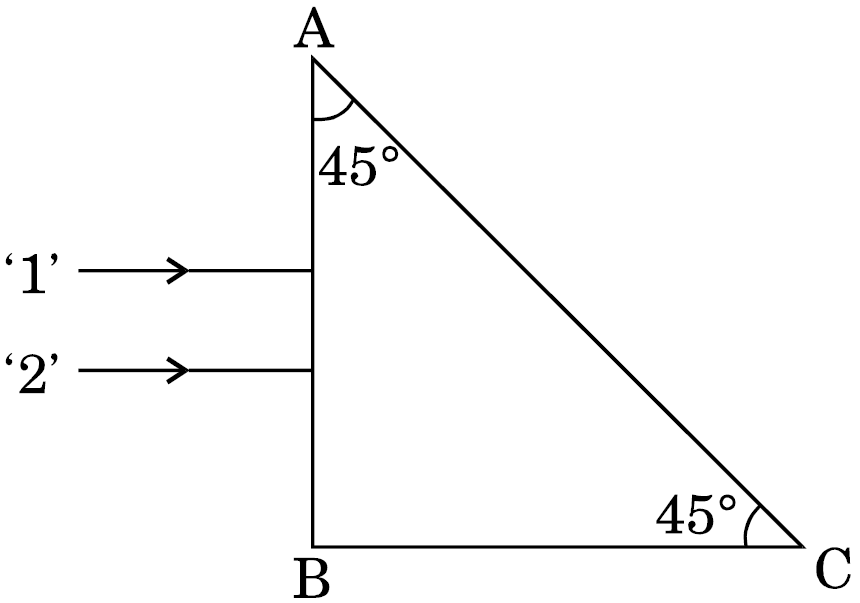
Two monochromatic rays of light are incident normally on the face AB of an isosceles right-angled prism ABC. The refractive indices of the glass prism for the two rays ‘1’ and ‘2’ are respectively 1.38 and 1.52. Trace the path of these rays after entering through the prism.

Why is there no dispersion in the light refracted through a rectangular glass slab?
12J of work has to be done against an existing electric field to take a charge of 0.01C from A to B. How much is the potential difference VB - VA?
57Co decays to 57Fe by $\beta^+-\text{ emission.}$- emission. The resulting 57Fe is in its excited state and comes to the ground state by emitting $\gamma-\text{rays}.$ The half-life of $\beta^+-\text{decay}$ is 270 days and that of the $\gamma-\text{emissions}$ is 10-8 s. A sample of 57Co gives 5.0 × 10⁹ gamma rays per second. How much time will elapse before the emission rate of gamma rays drops to 2.5 × 10⁹per second?
Express dielectric constant of a medium in terms of capacitance. What is its SI unit?
Explain the dependence of the electric potential generated at a great distance due to a small electric dipole, when the point of observation is (i) in the axial position, and (ii) in the equatorial position.
A neutron having kinetic energy 12.5eV collides with a hydrogen atom at rest. Nelgect the difference in mass between the neutron and the hydrogen atom and assume that the neutron does not leave its line of motion. Find the possible kinetic energies of the neutron after the event.
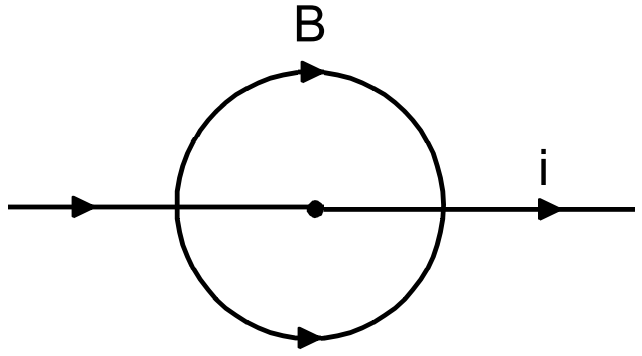
A conducting circular loop of radius a is connected to two Iong, straight wires. The straight wires carry current I as shown in figure. Find the magnetic field B at the centre of the loop.

Is neutral temperature always the arithmetic mean of inversion temperature and the temperature of the cold junction? Does the unit of temperature have an effect in deciding this question?
How are electro magnetic waves produced ?
Explain.