MCQ
In dilute alkaline solution, $MnO_4\,^-$ changes to
  • A
     $MnO_4\,^{2-}$
  • $MnO_2$
  • C
    $Mn_2O_3$
  • D
    $MnO$

Answer

Correct option: B.
$MnO_2$
b
$MnO_4^- \overset{O{H^\Theta }}{\rightarrow} MnO_2$

Need a full question paper?

Generate a complete, print-ready paper with questions like this in minutes — across 16+ boards, with answer keys.

Start Generating Free

Similar questions

The mechanism of $S _{ N } 1$ reaction is given as

$R - X \rightarrow R ^{\oplus} X ^{\ominus} \rightarrow R ^{\oplus} \| X ^{\ominus} \stackrel{ Y^\ominus }{\rightarrow} R - Y + X ^{\ominus}$

                     Ion pair       Solvent separated ion pair

A student writes general characteristics based on the given mechanism as:

$(a)$ The reaction is favoured by weak nucleophiles

$(b)$ $R^ \oplus$ would be easily formed if the substituents are bulky

$(c)$ The reaction is accompained by recemization

$(d)$ The reaction is favoured by non-polar solvents.

Which observations are correct $?$

In sulphur estimation. $0.471\,g$ of an organic compound gave $1.4439\,g$ of barium sulphate.The percentage of sulphur in the compound is $.............$(Nearest Integer)(Given: Atomic mass Ba: $137 u : S : 32 u , O : 16 u$ )
One mole of $S{O_3}$ was placed in a litre reaction vessel at a certain temperature. The following equilibrium was established $2S{O_3}$ $ \rightleftharpoons $ $2S{O_2} + {O_2}$ At equilibrium $0.6$ moles of $S{O_2}$ were formed. The equilibrium constant of the reaction will be
The reaction of $4$-methyloct-ene $P, 2.52 \mathrm{~g})$ with $\mathrm{HBr}$ in the presence of $\left(\mathrm{C}_6 \mathrm{H}_5 \mathrm{CO}_2\right)_2 \mathrm{O}_2$ gives two isomeric bromides in a $9: 1$ ratio, with combined yield of $50 \%$. Of these, the entire amount of the primary alkyl bromide was reacted with an appropriate amount of diethylamine followed by treatment with eq. $\mathrm{K}_2 \mathrm{CO}_3$ to given a non-ionic product $\mathrm{S}$ in $100 \%$ yield.

The mass (in $\mathrm{mg}$ ) of $\mathrm{S}$ obtained is. . . . . . .  [Use molar mass (in g mol ${ }^{-1}$ ) : $\mathrm{H}=1, \mathrm{C}=12, \mathrm{~N}=14, \mathrm{Br}=80$ ]
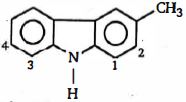
Identify the position where $E.A.S.$ can take place
The aqueous solution of disodium hydrogen phosphate is
Sodium oxide reacts with water to produce sodium hydroxide. $20.0\, \mathrm{~g}$ of sodium oxide is dissolved in $500\, \mathrm{~mL}$ of water. Neglecting the change in volume, the concentration of the resulting $\mathrm{NaOH}$ solution is $........\times \quad 10^{-1} \quad$ $M.$ (Nearest integer)

[Atomic mass $: \mathrm{Na}=23.0, \mathrm{O}=16.0, \mathrm{H}=1.0]$

The $IUPAC$ name of the following structure $(CH_3)C\cdot C\cdot C\cdot (CH_3)CH(CH_3)$ is :
According to Heisenberg’s uncertainty principle, the product of uncertainties in position and velocities for an electron of mass $9.1 \times {10^{ - 31}}\,kg$ is
Which one of the following is an $s$ - block element