Question
In discussing Doppler effect, we use the word "apparent frequency". Does it mean that the frequency of the sound is still that of the source and it is some physiological phenomenon in the listener's ear that gives rise to Doppler effect? Think for the observer approaching the source and for the source approaching the observer.
Answer

In both cases if observer approaches source or source approaches observer the apparent frequency is physiological phenomenon as the frequency of the sound is still the same but due to motion w.r.t. each other the apparent frequency changes.

Need a full question paper?

Generate a complete, print-ready paper with questions like this in minutes — across 16+ boards, with answer keys.

Start Generating Free

Similar questions

Find the average force needed to accelerate a car weighing 500kg from rest to 72km/h in a distance of 25m.
Depict the field-line pattern due to a bar magnet.
State the sign convention for applying Kirchhoff's loop rules.
Find the amount of silver liberated at cathode if 0.500A of current is passed through $AgNO_3$ electrolyte for 1 hour. Atomic weight of silver a 107.9 g/mole.
The battery discussed in the previous question is suddenly disconnected. Is a current induced in the other loop? If yes, when does it start and when does it end? Do the loops attract each other or repel?
Write formula for Bohr's orbit radius for hydrogen atom.
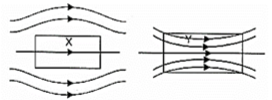
A uniform magnetic field gets modified as shown below, when two specimens X and Y are placed in it.

Image

i. Identify the two specimens X and Y.
ii. State the reason for the behaviour of the field lines in X and Y.
Consider a 10cm long portion of a straight wire carrying a current of 10A placed in a magnetic field of 0.1T making an angle of 53° with the wire. What magnetic force does the wire experience?
A rectangular coil of 100 turns has length 5cm and width 4cm. It is placed with its plane parallel to a uniform magnetic field and a current of 2A is sent through the coil. Find the magnitude of the magnetic field B if the torque acting on the coil is $0.2N\  m^{-1}.$
An electron accelerated by 1 kV travels 5 km towards conducting plate of infinite extension is moving in the direction perpendicular to the plate. Calculate the minimum surface charge density on the conducting plate so that the electron cannot collide with the plate.