MCQ
In electroplating, the article to be electroplated serves as
  • Cathode
  • B
    Electrolyte
  • C
    Anode
  • D
    Conductor

Answer

Correct option: A.
Cathode
a
Sulphuric acid is consumed on discharging.

Need a full question paper?

Generate a complete, print-ready paper with questions like this in minutes — across 16+ boards, with answer keys.
Start Generating Free

Similar questions

In the isoelectronic series of metal carbonyl, the $CO$ bond strength is expected to  increase in the order
The compound which is not isomeric with diethyl ether is
A first order reaction will have rate constant $5.78\times10^{-5}\, sec^{-1}$. How much part of reactant will remain after $10\, hours$
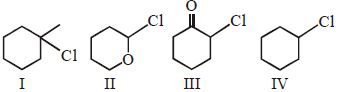
Arrange the following in there correct order of reactivity towards ${S_N}^1$
For a zero-order reaction: 2NH3​(g) → N2​(g) + 3H2​(g), the rate of reaction is 0.1atm/s. Initially only NH3​(g) was present at 3atm and the reaction is performed at constant volume and temperature. The total pressure of gases after 10s from the start of reaction will be:
The vapour pressure of water at room temperature is lowered by $5\%$ by dissolving a solute in it. Then the approximate molality of solution is
Degree of dissociation of an electrolyte does not depends on
For the reaction : $2A + B \to  A_2B$ ; the rate $= K[A]\, [B]^2$ with $K = 2.0\times10^{-6}\, lit^2\, mol^{-2}\, sec^{-1}$. Initial concentration of $A$ and $B$ are $0.2\, mol/lit$ and $0.4\, mol/lit$ respectively. Calculate the rate of reaction after $[A]$ is reduced to $0.12\, mol/litre$.
Arrange the following compound in decreasing order of reactivity towards nucleophilic addition reaction

${\left( {I} \right)}$  ${{C_6}{H_5}COC{H_3}}$

${\left( {II} \right)}$  ${C{H_3}COC{H_3}}$

${\left( {III} \right)}$  ${C{H_3} - CHO}$

Which is the correct sequence in the following, poperties? For the correct order mark $(T)$ and for the incorrect order mark $(F)$

$(a)$ Lewis acidity order : $SiF_4 < SiC_{4} < SiBr_4 < Sil_4$

$(b)$ Melting point : $NH_3 > SbH_3 > AsH_3 > PH_3$

$(c)$ Boiling point : $NH_3 > SbH_3 > AsH_3 > PH_3$

$(d)$ Dipole moment order : $NH_3 > SbH_3 > AsH_3 > PH_3$